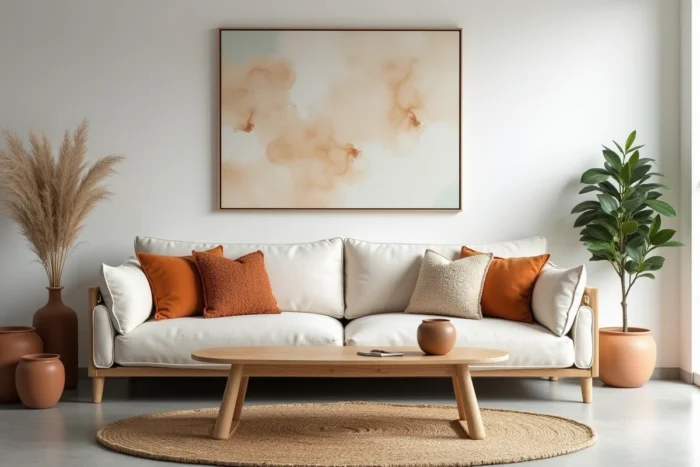
Between the return of glass blocks, the rise of augmented biophilia, and the resurgence of maximalism in small touches, interior decoration in 2026 blurs the lines between once-opposed styles. What are the real differences between these trends, and which ones will sustainably transform an interior rather than fizzling out in a few months?
Glass Blocks and Wood Burl: A Comparison of Decorative Materials
Two materials are vying for attention this year in modern interiors. The glass block, once thought to be confined to 1980s bathrooms, is making a comeback with a technique called color capping, which involves tinting the glass on the surface to achieve colored reflections without blocking the light.
Wood burl, on the other hand, refers to a cut of wood made from the natural growths on the trunk. The irregular patterns that result give each piece of furniture or wall panel a unique character.
| Criterion | Glass Block (Color Capping) | Wood Burl |
|---|---|---|
| Visual Effect | Translucent, colored reflections, amplifies natural light | Organic patterns, dense grain, tactile surface |
| Suitable Pieces | Living room, kitchen, partition wall | Accent furniture, accent wall, countertop |
| Maintenance | Simple cleaning (glass), sensitive to fingerprints | Regular treatment to maintain wood’s luster |
| Stylistic Durability | Making a comeback, strong visibility in 2026 | Timeless material, valued for the rarity of pieces |
The glass block works best in a space that lacks light or requires visual separation without complete partitioning. Wood burl, on the other hand, is essential when the goal is to anchor a room around a strong sculptural element. Combining both in the same living room is possible, provided that color capping is limited to one partition and wood burl to a single piece of furniture.
To explore other material and style combinations, Place A’s decor ideas gather proposals categorized by room and ambiance.
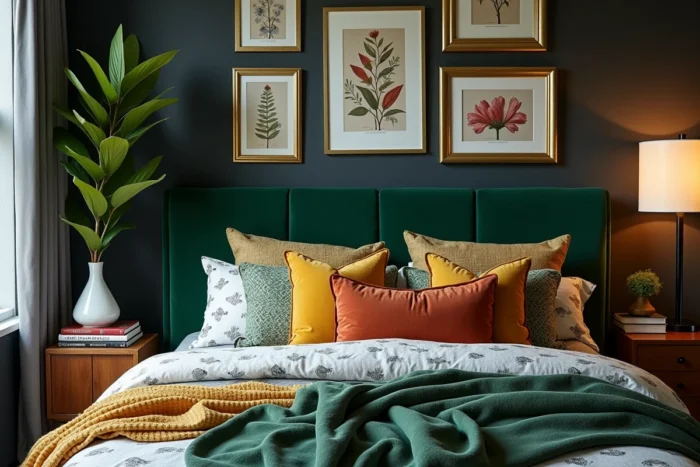
Augmented Biophilia vs. Sensory Decoration: Two Approaches to Interior Well-Being
The presence of green plants in a living room is nothing new. What changes is the notion of augmented biophilia: we no longer just place a ficus in a corner; we design the entire space around organic shapes, living materials, and immersive atmospheres.
So-called sensory interiors take this logic further. The decoration is designed to stimulate multiple senses simultaneously: tactile materials on the walls, adjustable lighting according to the time of day, and integrated scents in the furniture.
What Distinguishes These Two Approaches
- Augmented biophilia prioritizes the visual and spatial: curves in furniture, structured plant walls, raw wood left exposed to evoke a natural environment.
- The sensory approach adds touch, smell, and light management: textured fabrics on sofas, loops on walls, discreet diffusers, and adjustable indirect lighting.
- Both can easily combine in a room like the living room or bedroom but require a budget compromise: natural materials cost more than imitations, and programmable lighting represents a separate investment from the furniture.
Biophilia focuses on the living, while sensory focuses on the experience. In a small space, forcing both registers risks overwhelming the room. It’s better to choose a primary axis (either plant or textile) and enrich it with one or two elements borrowed from the other.
Maximalism in Small Touches: Balancing Style Mixing in Modern Decor
Maximalism in 2026 does not resemble the saturated interiors sometimes associated with this term. It is rather a deliberate yet measured mix of styles: mismatched objects, patterns coexisting on the same wall, a touch of decorative humor in an otherwise minimalist room.
The idea is not to accumulate everything but to break the monotony of an overly uniform interior. A living room with white walls and a sober sofa can accommodate a vintage gold mirror, a brightly patterned geometric cushion, and a handcrafted ceramic lamp without tipping into visual chaos.
Three Guidelines to Avoid Crossing the Line
Color remains the simplest lever to manage. An accent wall in a bold color (terracotta, teal, sage green) is enough to anchor maximalism without it contaminating the entire room.
Decorative objects work best in odd groups. Three vases of different sizes on a shelf create a visual rhythm; four aligned objects produce a display effect.
Limiting patterns to two families per room prevents cacophony. A floral pattern on cushions can coexist with stripes on a rug, but adding a third pattern (like houndstooth, for example) on the curtains fragments attention.
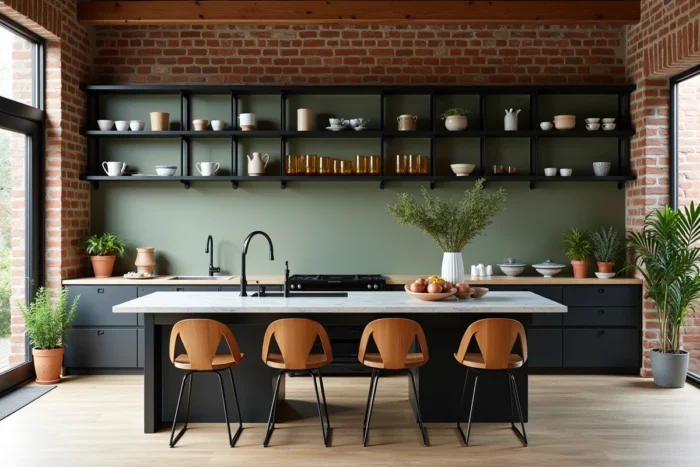
Colors and Walls: Combinations That Structure an Interior in 2026
Neutral palettes still dominate the bases (walls, large furniture), but vivid colors are returning on targeted elements. The principle is simple: color no longer covers entire pieces; it punctuates.
An accent wall painted in a strong hue, paired with three light walls, alters the perception of depth in a living room or kitchen. Warm tones (ochre, rust) visually bring a wall closer, which is suitable for elongated rooms. Cool tones (blue-gray, water green) create a sense of receding, useful in small spaces.
Wall textures are also gaining ground. A lime plaster, a fluted paneling, or a reconstituted stone covering adds relief without resorting to color. This option suits interiors where one prefers to play on surface design rather than color palette.
The underlying trend remains personalization through layers: a sober base, one or two strong elements in color or texture, and objects that tell a story unique to the place. A modern interior in 2026 is recognized less by a style than by the coherence of its choices, whether they lean towards tempered minimalism or contained maximalism.