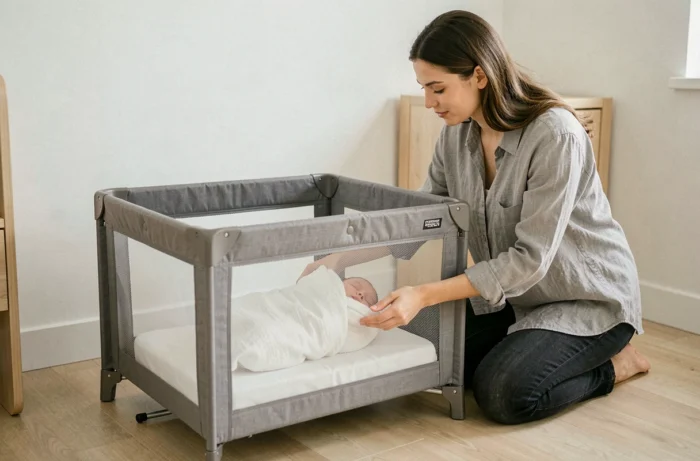
Traveling with an infant requires rethinking every inch of luggage. The classic travel crib, with its generous size, often takes up the space of a small suitcase in the trunk. Mini and compact models address this specific issue: providing a safe sleeping space for baby without sacrificing all available space. However, it’s essential to know which criteria to focus on, as a smaller crib is not automatically a suitable crib.
EN 12227 Standard and Compact Cribs: How Reduced Size Affects Safety
Buying guides often mention European standards without going further. For travel cribs, the reference to know is the EN 12227:2010 standard. It governs stability, side height, risk of entrapment, and the requirement for a flat sleeping surface.
In a mini model, these constraints become more pronounced. The walls are lower than on a standard crib, which shortens the usage period. A baby who starts to stand can reach the top edge sooner than expected.
Also, check for the presence of mandatory warnings visible on the product: mattress thickness limits, exclusive use on flat surfaces, suffocation risks. A compact crib sold without these clearly printed mentions on the fabric or frame is a warning sign, regardless of the brand.
When choosing a mini and compact travel crib, this verification takes a few seconds in-store and avoids unpleasant surprises once the product is unpacked at the grandparents’ house.
Folded Weight and Actual Dimensions: The Two Numbers to Compare Before Purchase
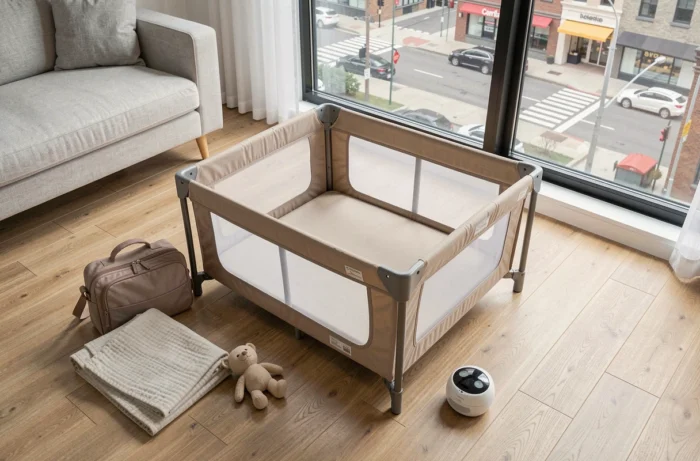
Have you ever noticed that two cribs advertised as “compact” can have very different sizes when folded? Weight alone is not enough. A lightweight model but long when folded will be difficult to slide into a trunk that’s already packed. Conversely, a slightly heavier crib that folds into a short, narrow block can fit in a closet or behind a car seat.
Always compare folded dimensions, not just weight. Take a tape measure and measure the actual space you have in your trunk or closet. Note the available height, width, and depth, then compare them to the product specifications.
The provided transport bag also gives a reliable indication. If it resembles a classic sports bag, the crib will be manageable on public transport or on foot. If it resembles a ski bag, the claimed compactness is relative.
Compact Travel Crib Mattress: Thickness, Fit, and Common Pitfalls
The mattress is the recurring weak point of travel cribs, and mini models are no exception. The mattress that comes with the crib is often thin, sometimes barely padded. The temptation is strong to add a second, thicker mattress for improved comfort.
Adding a mattress not intended by the manufacturer is not recommended. A mattress that is too thick or slightly different in dimensions creates a gap between the edge of the crib and the sleeping surface. This is precisely the type of gap that safety standards aim to eliminate, as an infant can get their face stuck in it.
Here are some concrete guidelines to evaluate the provided mattress:
- Press firmly with your palm in the center: the mattress should regain its shape in less than two seconds, indicating sufficient density for the baby’s back.
- Check the fit at all four corners of the crib. No finger should fit between the mattress and the wall.
- Ensure that the cover is removable and machine washable, as a travel crib gets dirty quickly.
Folding and Unfolding the Travel Crib: The Test to Do in Store

Online demonstration videos always show a parent unfolding the crib in seconds. The reality at two in the morning, tired, in an unfamiliar room, is often different. The folding mechanism is a choice criterion that should be physically tested.
Why is this choice crucial? Because a poorly designed compact crib at the joints ends up in a closet after two uses. The best travel crib is one that you will be willing to set up every night without frustration.
Here’s what distinguishes a good mechanism:
- Unfolding is done by pulling a single handle, without having to push down the bottom separately. Models with self-deploying bottoms are faster.
- Folding does not require excessive force. If you have to press your full weight on the center to lock it, the system will eventually wear out the frame.
- The locking mechanism emits an audible click. This click confirms that the sides are securely locked, preventing sagging during the baby’s sleep.
- A good compact crib can be set up and folded in under a minute, even for someone who is discovering it.
Age Limit and Actual Usage Duration of a Mini Travel Crib
A standard travel crib is generally used from birth until about three years old. A mini model has a shorter usage duration, often limited to the first few months or until the child reaches the weight limit indicated by the manufacturer.
This information is found on the label or in the manual, but few parents check it before purchase. The consequence: a crib bought for a six-month-old baby becomes unusable four or five months later, much sooner than expected.
If your child is already close to the height or weight limit, a mini format is not the right investment. It’s better to opt for a mid-sized folding crib, slightly bulkier but usable for a longer time. Check the weight limit before purchase, not after.
Ultimately, the choice of a compact travel crib rests on three trade-offs: regulated safety versus minimal bulk, mattress comfort versus total weight, and actual usage duration versus budget. Cross-referencing these criteria with your travel habits, trunk size, and your baby’s age yields a much more reliable result than any generic ranking.