When attempting Astavakrasana for the first time, the problem is almost never a lack of strength in the arms. We collapse because the thigh slips off the tricep, because the pelvis rotates, or because we hold our breath without realizing it.
The eight-angle pose is an advanced arm balance in yoga that simultaneously engages the wrists, shoulders, core, and hips. Its name comes from the sage Astavakra, whose body had eight curves, and the Sanskrit word breaks down into asta (eight) and vakra (curved).
Most Common Blockage in Astavakrasana: The Thigh Grip
The majority of failures in this pose come from the same place: the contact between the upper thigh and the arm. We place the arm under the thigh, think it holds, and at the moment of lifting the pelvis off the ground, the leg slips toward the elbow.
The problem is rarely muscular. It is a fault in initial placement. The thigh must rest as high as possible on the shoulder, not just on the tricep. To achieve this, we start seated, knee bent, and literally thread the arm under the thigh while pushing the shoulder forward. The foot remains flexed (dorsiflexion) to lock the grip.
If the skin slips, we practice on a dry fabric, with bare arms. Feedback varies on this point, but many practitioners find that a slight warm-up that causes a thin layer of sweat improves grip rather than degrades it. A detailed guide on astavakrasana on Les Jardins Du Yoga precisely describes this gripping mechanics between thigh and shoulder.
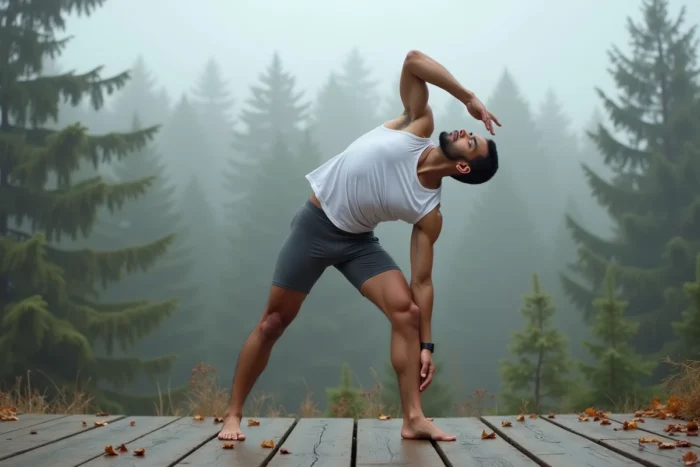
Preparing the Hips and Core for the Eight-Angle Pose
We do not prepare for Astavakrasana by doing push-ups. The pushing strength of the arms is the last piece of the puzzle. What is initially lacking is the external rotation of the hip combined with powerful oblique engagement.
Three Concrete Preparatory Exercises
- Eka Pada Sirsasana in the floor version: lying on the back, we bring the foot behind the head (or as far as possible). This exercise opens the hip in external rotation and deep flexion, exactly the movement required to hook the thigh on the shoulder.
- Side plank with the raised knee brought toward the elbow: we hold the side plank and bring the knee closer to the supporting arm. This activates the obliques in the same lateral compression pattern as the final pose.
- Static Chaturanga (a few breaths): we maintain the low position of the yoga push-up, elbows tight against the ribs. This exercise strengthens the triceps and shoulder stabilizers in the exact angle where they work in Astavakrasana.
We chain these three movements at the beginning of the session before attempting the full pose. Jumping directly into the balance without this preparation relies on momentum to compensate for a lack of mobility.
Breathing and Core Engagement: The Role of Breath in Arm Balance
In Astavakrasana, holding the breath causes an almost immediate loss of control. The apnea reflex stiffens the diaphragm, preventing the obliques from doing their lateral stabilization work.
The concrete instruction: we inhale during the placement phase (thigh on the shoulder, hands on the ground), then exhale slowly at the moment of lifting the pelvis and extending the legs to the side. It is during the exhalation that the transverse abdominal muscle contracts the most, and it is precisely this contraction that keeps the pelvis in the air.
Once in position, we breathe through the nose, with slightly longer exhales than inhales. If we can no longer breathe calmly, it is a reliable signal that the pose exceeds our current capacity. We come down, recover, and try again.
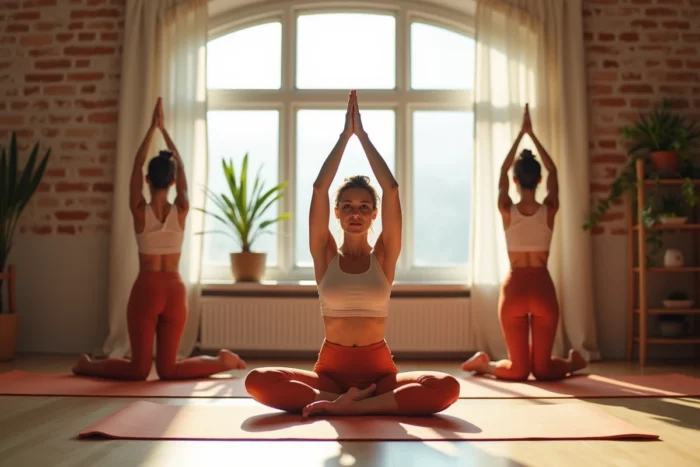
Astavakrasana and Meditative Practice: Beyond Physical Performance
Contemporary teachers directly link this pose to the Ashtavakra Gita, the text attributed to the sage Astavakra. The central message of this text revolves around the disidentification from the body and emotions, a posture of inner witnessing. In practice, this translates into a precise instruction: observe the effort, the fear of falling, and the pride when the pose holds, like images on a screen.
This meditative thread transforms the exercise. Instead of forcing to “succeed” in the pose, we use it as a laboratory for discernment (viveka in Sanskrit). Physical intensity becomes a support for attention, not an end in itself.
Using Props to Progress Towards Astavakrasana
Modern approaches systematically integrate props for complex arm balances. Props are not crutches for beginners. They allow us to work on the components of the pose separately.
- Two blocks under the hands raise the ground and provide more room to lift the pelvis. We gain a few centimeters that change everything when the hips still lack mobility.
- A strap around the ankles keeps the feet hooked together during the lateral extension phase. The crossing of the ankles is the key to leg stability in the final pose.
- The wall behind the back serves as a proprioceptive reference. We do not lean against it, but its presence reassures and allows us to correct the alignment of the torso without fear of tipping backward.
The goal is to remove the props one by one over several weeks as the body integrates the motor patterns. There is no rush.
The eight-angle pose rewards patience and precision of placement much more than brute strength. Working on the thigh-shoulder grip and breathing on the exhale resolves the majority of blockages. The rest is regular repetition, a few breaths at a time.