
Small white cottony clusters under the leaves of your oleander, a sticky substance on the stems of your citrus: scale insects often settle in without warning. Black soap remains one of the most commonly used natural treatments by gardeners in France to get rid of them. However, its effectiveness depends on details that many neglect, starting with the type of scale insect targeted.
Mealybugs or armored scale: black soap doesn’t work the same
You may have noticed that some scale insects look like small cotton flakes, while others form sorts of small brown shields stuck to the stems? This distinction changes everything for your treatment.
Black soap works by dissolving the waxy layer that protects the insect’s body, then suffocating it. On mealybugs (those that leave a white fluff), this waxy layer is thin and not very resistant. Black soap passes through it easily.
On armored scale, the rigid shell partially blocks the action of the product. According to a technical sheet published by Laptitegraine in 2025, diluted black soap shows good effectiveness on mealybugs but limited effectiveness on armored scale. For the latter, a prior manual cleaning (with a cloth soaked in alcohol or a toothbrush) significantly improves the result.
Before preparing your sprayer, take the time to closely observe your plants. A black soap treatment against mealybugs may be sufficient on its own, while an infestation of armored scale requires a combined approach.
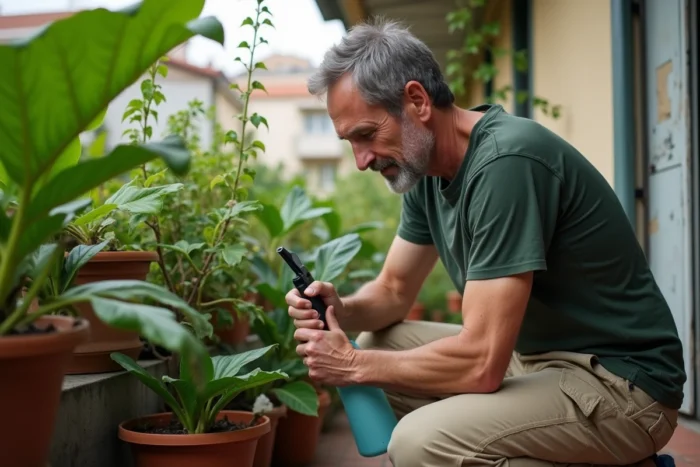
Dosage of black soap and preparation of the insecticidal solution
The dosage makes the difference between an effective treatment and one that damages your plants. Too concentrated, black soap can burn the most sensitive leaves (citrus, ferns, young rose shoots). Too diluted, it slides over the scale insects without reaching them.
The right proportion for the garden
The most commonly recommended base by websites specializing in natural gardening is simple: a few tablespoons of liquid black soap per liter of lukewarm water. Lukewarm water helps dissolve the soap and improves the adherence of the mixture on the leaves.
Two points to check before starting:
- Choose a black soap based on olive oil or linseed oil, without fragrance or additives. Scented household black soaps contain substances that can be phytotoxic.
- If you are using paste black soap, first dilute it in a little hot water before adding the rest of the volume to obtain a homogeneous mixture.
- Always test on a few leaves before treating an entire plant, especially on indoor plants and young seedlings in the vegetable garden.
Add oil to enhance adherence
A tip that experienced gardeners know well: add a drizzle of vegetable oil (rapeseed or sunflower) to the solution. The oil strengthens the film that settles on the body of the scale insect and slows down its evaporation. The mixture of black soap and vegetable oil acts longer on the insects than a soap-only solution.
When and how to spray for lasting results
Preparing the right solution is not enough. The timing of the application and the spraying technique are just as important as the dosage.
The right time slot
Spray early in the morning or late in the day, never in full sun. Heat speeds up evaporation and can cause burns on wet foliage. Overcast weather without rain forecast in the following hours represents the ideal time slot.
The spraying technique
Scale insects settle under the leaves, in the axils of the stems, and in the folds of the bark. Spraying only the top of the foliage is like treating next to them. Focus on the underside of the leaves and the joints of the branches.
One pass is almost never enough. Scale insect eggs resist black soap, and new larvae hatch after treatment. Repeat the application every five to seven days for three weeks to intercept each generation. It is this regularity that makes the difference between a temporary result and a lasting elimination.
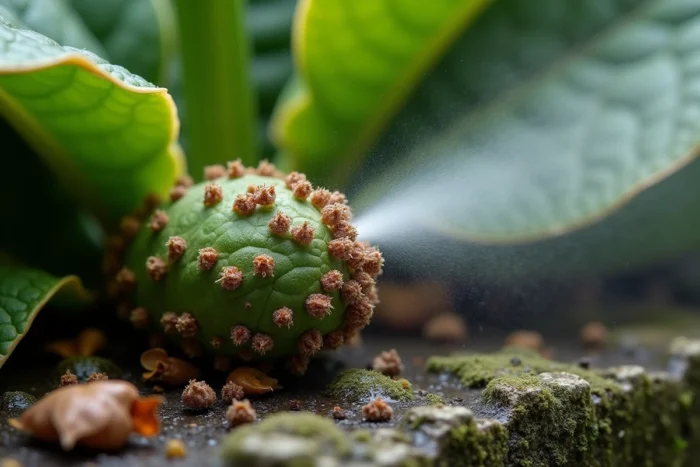
Protecting bees and beneficials during treatment
Black soap is a natural and biodegradable product, but that doesn’t mean it is harmless to all insects. Through direct contact, it can affect garden beneficials like ladybugs and lacewings, which are precisely your allies against scale insects.
According to comparative data published by Laptitegraine in 2024, diluted black soap presents a low to moderate risk for bees and moderate risk for beneficials through direct contact.
Some concrete precautions significantly reduce this risk:
- Never treat during the flowering of a foraged plant. Wait until the flowers have faded or treat before the buds open.
- Prefer spraying in the evening, after the return of pollinators to their nests.
- If ladybugs are already settled on the infested plant, gently remove them before spraying. They complement the work you are doing.
A well-timed black soap treatment preserves the balance of the garden while eliminating scale insects. Poorly planned, it can slow down the natural biological control that your beneficials are providing for free.
For armored scale that resist after three weeks of black soap treatment, an application of white oil in winter (when the plant is in a vegetative rest) effectively completes the job by smothering the individuals protected under their shell. Black soap in spring, white oil in winter: this combination covers both fronts without resorting to a single synthetic chemical product.