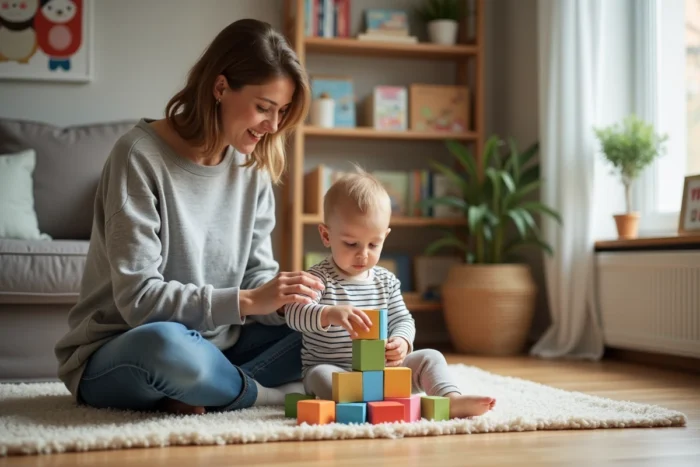
The development of a child relies on a set of skills that are built through the repetition of daily actions. Language, motor skills, emotional regulation, the ability to organize a task: each acquisition follows a specific order and depends on the quality of interactions with the immediate environment. Supporting this process requires less multiplying activities and more understanding the mechanisms at play, then adjusting one’s parental stance accordingly.
Metacognitive Questions in Daily Life: Teaching a Child to Manage Their Effort
Metacognition refers to the ability to reflect on one’s own mental functioning. For adults, this seems natural. For children, this skill does not yet exist spontaneously: it needs to be taught and then reinforced through practice.
Educational services like Alloprof in Canada recommend integrating simple metacognitive questions into daily routines. Three concrete examples: “How much time do I need for this task?”, “Is this place conducive to my concentration?”, “Do I need a break now?”.
These questions are not only aimed at school homework. They also apply during tidying up, preparing the backpack, or a construction game. The child learns to self-regulate their attention and organization, even outside of school. The goal is not to impose a rigid framework but to provide them with a reusable mental tool in all situations.
Additional resources on children’s learning and daily life are gathered on the Maman du Net for children website, which covers several age groups.
Child-Friendly Environment: What Really Matters in Setup
Most parenting guides recommend adapting the environment. The advice often remains vague. Two concrete principles deserve further exploration.

Physical Accessibility of Everyday Objects
A child who has to ask for help to reach their glass, shoes, or a book is not practicing autonomy; they are practicing asking. Placing frequently used items at the child’s height turns every routine into an opportunity for them to act independently. This applies to the bathroom (toothbrush, fixed step stool), the kitchen (plates at the bottom, accessible water bottle), and the entrance (low coat rack, shoe basket).
Reduction of Visual Distractions
A cluttered play or work space scatters attention. Limiting the number of visible toys at any given time, by practicing regular rotation, helps the child focus longer on an activity. This principle also applies to the homework corner: a clear surface, direct lighting, no screens in the line of sight.
Screens and Daily Rhythm: Key Guidelines to Know
The official French guidelines are now clear: no screens before three years old, then very limited use and always accompanied. This recommendation is not based on a moral principle but on observations regarding the development of language, attention, and sleep.
In daily life, the challenge is not knowing the rule but applying it. Two levers work better than a strict prohibition:
- Define fixed screen-free times during the day (meals, the first hour after waking, the last hour before bed) rather than negotiating on a case-by-case basis
- Replace screen time with a low-preparation activity (free drawing, playdough, shared reading) to avoid the void that prompts turning the screen back on
- Use the screen actively when it is allowed (watching together, commenting, asking questions about the content) instead of leaving it in passive mode
The regularity of the daily rhythm, with stable time markers, contributes as much to development as the content of the activities themselves. A child who knows what comes after snack time or after bath time wastes less energy in uncertainty.

Trust and Right to Make Mistakes: The Parental Stance that Fosters Learning
Allowing a child to fail at a task appropriate for their age produces more lasting learning than showing them the correct method right away. The mechanism is simple: the mistake generates feedback that the child actively processes, while passive demonstration engages little of their working memory.
In practical terms, this means resisting the urge to immediately correct a poorly buttoned shirt, a drawing “upside down,” or an unstable tower of blocks. Parental intervention is better expressed as a question (“Do you want to try another way?”) rather than a direct correction (“No, like this”).
This stance does not apply to situations involving physical safety, where the adult intervenes without delay. The distinction between the two contexts, real danger versus simple clumsiness, is part of daily parental adjustment.
Age-Appropriate Tasks: Concrete Guidelines
Autonomy progresses in stages. Offering a task that is too complex generates frustration, while a task that is too easy brings no learning. Here are some useful guidelines:
- Around two years: put away a toy in a designated bin, throw a wipe in the trash, choose between two pieces of clothing
- Around three to four years: dress with simple clothes (without buttons or laces), wash hands independently, place their plate on the counter after a meal
- Around five to six years: prepare a simple breakfast (pouring cereal, serving water), fold a simple piece of laundry, organize their backpack with a visual aid (illustrated list)
- From school age: plan a task in several steps, estimate the time needed, ask for help in a targeted manner (“I need help with X” rather than “I can’t do it”)
Each stage consolidates before moving on to the next. Accelerating the timeline does not produce a more advanced child but a child who is less confident in the face of difficulty.
The daily development of a child relies less on the quantity of activities proposed than on the regularity of routines, the quality of interactions, and respect for the rhythm appropriate to each age. A well-placed metacognitive question, a clear environment, or a mistake allowed to happen often suffice to trigger lasting progress.