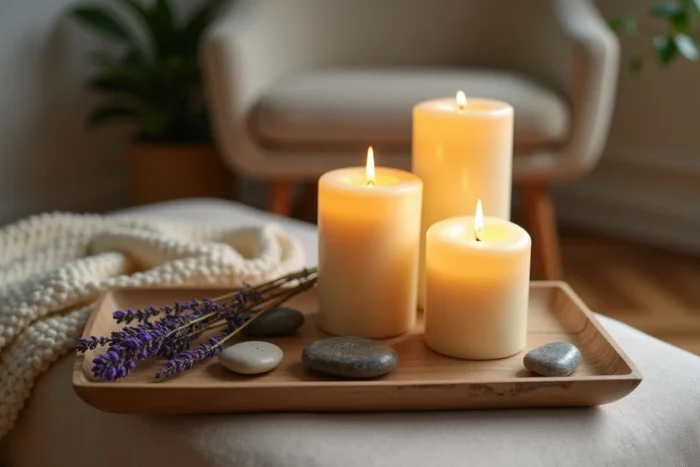
Lighting three candles simultaneously in a room creates a distinct luminous and olfactory effect compared to a single candle. The multiplication of flames alters the distribution of light, the diffusion of aromatic compounds, and the overall sensory perception of the space. This principle, used in both wellness practices and intention rituals, is based on concrete mechanisms that deserve to be detailed.
Candle and air quality: what the wax really changes
Before discussing wellness, it is essential to understand what happens chemically when a candle burns. The composition of the wax determines the substances released into the surrounding air. A vegetable wax (soy, coconut, rapeseed) does not produce the same combustion residues as a paraffin wax derived from petroleum.
Beeswax or soy wax candles generate less soot than their paraffin counterparts. This technical detail has a direct impact on indoor air quality, especially when multiple candles burn simultaneously in a closed space.
A point rarely addressed in competing articles: the candle is not designed to intensely scent a room. Its primary role remains the creation of soft light and ambiance. For a powerful ambient fragrance, scented wax melts heated on a fragrance burner are more suitable, as they do not produce combustion and diffuse odor compounds more concentratedly.
When you explore the benefits of lighting 3 candles, the composition of each candle matters as much as their number. Three synthetic paraffin candles in a poorly ventilated room provide no benefits, regardless of the associated ritual.
- Soy wax melts at a low temperature and gradually releases essential oils, prolonging the aromatic diffusion without saturating the air.
- Beeswax slightly purifies the atmosphere through negative ionization during combustion, a documented but modest phenomenon.
- Cotton or wooden wicks produce less soot than metal-core wicks, reducing fine particulate matter in suspension.
Three flames and intention ritual: how it works
The number three in candle usage is not arbitrary. It is rooted in an ancient tradition related to esotericism and rituals of protection, love, or energy. Each candle represents a dimension: the body, the mind, and the soul, or the past, the present, and the future according to different currents.
Contemporary practice has shifted towards personal development. Several coaches and wellness practitioners recommend setting a clear intention when lighting each candle. The first flame symbolizes what you wish to release, the second what you cultivate, and the third what you call forth.
This micro-ritual functions as a psychological anchor. The repeated gesture of lighting three candles creates a sensory signal that the brain gradually associates with a state of calm or concentration. The flame captures visual attention, slows the breathing rate, and facilitates mental refocusing.
The meaning of candle colors in rituals
The color of the candle carries symbolic meaning in esoteric practices and intention rituals. A red candle is associated with love and vital energy. White symbolizes purification and protection. Green is linked to prosperity and health.
Combining three different colors allows for structuring a ritual around several complementary intentions. This approach remains symbolic, but it gives the ritual a concrete dimension that helps formalize its objectives.
Candlelight and daily wellness: effect on stress and sleep
The light of a candle falls within a warm spectrum, around 1,800 kelvins. This color temperature is significantly lower than that of screens (about 6,500 kelvins) and white LED lighting. Exposure to warm light in the evening reduces retinal stimulation and promotes melatonin production, the hormone that regulates the sleep-wake cycle.
With three candles, the lighting remains dim but sufficient for reading or conversation. The distribution of multiple naked flame light sources eliminates harsh shadows and creates a uniform and soothing visual environment, unlike a single point light source.
Adding a suitable fragrance enhances this effect. Lavender and chamomile are the two most documented scent families for their relaxing action. Eucalyptus or peppermint, on the other hand, activate a state of alertness and concentration.
Creating an effective candle routine
A ritual of three lit candles becomes more effective when associated with a fixed schedule and a dedicated space. The brain registers the overall sensory context (light, smell, gesture, moment) and triggers the desired state more quickly with repetitions.
- Choose a regular time slot, ideally at the end of the day, to mark the transition between activity and rest.
- Place the three candles in a spaced triangle to evenly distribute light and fragrance throughout the room.
- Turn off screens during the ritual to maximize the effect of warm light on the nervous system.
- Associate the lighting with a mentally formulated intention, even brief, to anchor the gesture in a conscious approach.
Candles and the wellness market: an underlying trend
The global candle market is experiencing a significant growth driven by the demand for home wellness. Recent market studies project continuous sector growth until 2034, fueled by the appeal of cozy atmospheres and natural products.
This dynamic has a concrete effect on the quality of available products. Artisan manufacturers now offer vegetable waxes, lead-free wicks, and fragrances formulated from pure essential oils. Consumers have a broader choice to create a trio of candles suited to their needs.
The candle is no longer just a decorative object. It is part of a holistic approach where the act of lighting three flames becomes a personal care act, structured by intention and supported by material choices consistent with an indoor air quality requirement.