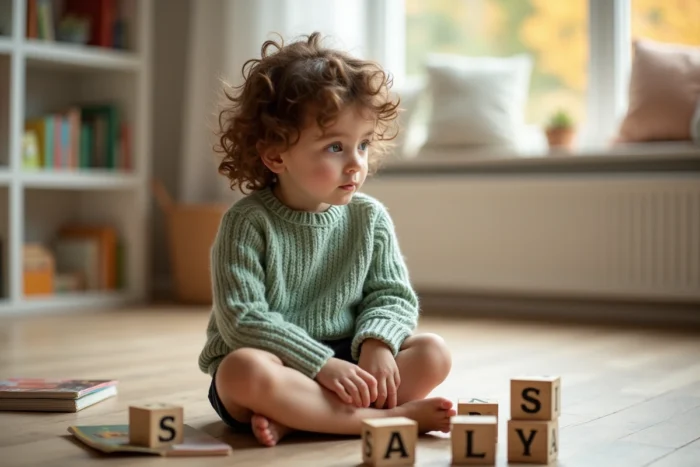
Sacha is one of those names that is recognized at first sound. Two syllables, a soft sound, a strong identity. This Russian diminutive of Alexander has established itself in France since the 2000s, carried by a wave of short and unisex names that continues to attract young parents.
Why the spelling Sacha or Sasha changes everything
You may have noticed that Sacha is sometimes spelled Sasha, with an English “sh.” This graphic detail alters the perception of the name, as well as its distribution between girls and boys.
With the classic spelling Sacha, the name remains predominantly masculine. Data compiled by name enthusiasts on French-speaking forums confirm a ratio close to 95% of male assignments since 1900.
The variant Sasha tells a different story. It is distributed in a much more balanced way, around 58% for boys and 42% for girls. The Anglo-Saxon influence plays a direct role here: in English-speaking countries, Sasha is perceived as a feminine name as much as a masculine one.
For parents who want a clearly masculine name, the French spelling Sacha remains the most readable choice. For those seeking a truly embraced unisex option, Sasha broadens the spectrum. It’s not just a matter of taste; it’s also a social signal that those around will decode differently. You can discover trends on Maman du Quotidien to delve deeper into this aspect.
Greek etymology of the name Sacha: what “defense of humanity” really means
The root of Sacha is Greek, not Russian. The name comes from Alexander, which is formed from two elements: “alexein” (to repel, to defend) and “andros” (man, humanity). Sacha thus means “defense of humanity”, an ambitious etymology for such a short name.
This transition from Greek to Russian occurred through gradual adoption. Alexander was a name of tsars and Orthodox saints. The diminutive Sacha became in Russia the equivalent of what “Alex” represents in the English-speaking world: a familiar, affectionate form used in everyday life.
From diminutive to full name
In Russia, no one registers a child as “Sacha” in civil records. It’s a nickname, a hypocoristic linked to Alexander or Alexandra. France made a different choice: here, Sacha is an official name, registered as such on birth certificates.
This autonomy of the diminutive partly explains its success. Sacha stands alone, without needing the full name to exist. It carries a long history (that of Alexander the Great, the tsars, Slavic culture) while remaining modern and light.
Sacha unisex name: a success linked to current trends
Three converging factors explain why Sacha remains at the top of the rankings:
- The preference for short names: since the early 2000s, French parents have favored two-syllable names. Sacha, like Léo, Noah, or Mila, fits this format that is easy to remember and sounds good in several languages.
- The appeal of unisex names: a name that can be worn by a boy or a girl appeals to parents who reject overly marked assignments. Sacha checks this box, even if usage remains predominantly masculine.
- The cultural Russo-Anglophone influence: between Francophone personalities (Sacha Guitry, Sacha Distel) and international figures (Sacha Baron Cohen, Alexander “Sascha” Zverev), the name circulates in several cultural universes without being tied to just one.
Sacha peaked in assignments in the early 2010s, with over 3,000 boys named this way in a single year. Since then, the numbers have slightly decreased, but the name remains among the most given in France. It still exceeds 2,000 annual assignments.
A name that ages well
The average age of Sacha in France is around 29 years. This means that the first “modern” Sachas are now young adults. The name is therefore neither too new nor too old.
This intermediate position protects it from the brutal fashion effect. Sacha does not have the profile of a fleeting name that disappears after a decade. Its trajectory resembles that of Lucas or Hugo: a rapid rise, a lasting plateau, then a slow decline without ever falling into oblivion.

Famous Sachas: the figures who have carried the name
The name owes part of its notoriety to a few prominent personalities from the Francophone and international world:
- Sacha Guitry (1885-1957), playwright, director, and figure of French boulevard theater. Son of actor Lucien Guitry, he wrote over one hundred thirty plays and several films that have become classics.
- Sacha Distel (1933-2004), guitarist, composer, and singer, known for his popular songs and his image as an elegant seducer.
- Sacha Baron Cohen, British comedian and director, creator of the characters Borat and Ali G.
- Alexander “Sascha” Zverev, German tennis player of Russian descent, whom his family continues to call by this traditional diminutive.
These figures cover very different eras and universes. Guitry anchors the name in French cultural heritage. Baron Cohen gives it an international and humorous dimension. Zverev recalls the Slavic origin and the familial use of the diminutive.
Feast and patron saint of Sacha
Sacha is celebrated on January 20, the day of Saint Sebastian, linked to the saints’ calendar via Alexander. Some calendars also propose April 22 (Saint Alexander). The date of January 20 remains the most commonly retained.
The name does not have its own patron saint, as it is a diminutive that has become autonomous. This absence poses no administrative problem in France, where the choice of name has been free since 1993, provided it does not harm the child.
Sacha remains a solid name for parents seeking a balance between originality and familiarity. Its dual Greek and Slavic roots, its short sound, and its unisex usage give it a longevity that many trendy names will not experience.