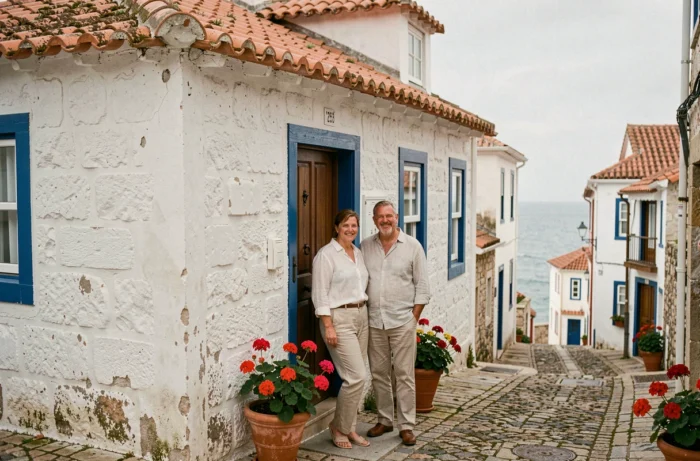
A fisherman’s house in Portugal refers to a property built of stone or traditional masonry, usually single-storey, located in a coastal village linked to fishing activities. Its surface rarely exceeds 80 to 100 square meters, and its value relies as much on its coastal location as on its renovation potential. This type of property is increasingly attracting foreign buyers, particularly French, for reasons that go beyond the simple tourist appeal of Portugal.
Fixed IMT rate for non-residents: what changes with Decreto-Lei n.º 97/2026
Since the summer of 2026, Portugal has applied a fixed IMT rate of 7.5% for non-residents on residential properties. This reform, stemming from Decreto-Lei n.º 97/2026, replaces the previous progressive scale that applied equally to residents and non-residents.
For a French buyer targeting a fisherman’s house, this change alters the profitability calculation from the moment of acquisition. The entry cost increases for low-value properties, where the old scale provided more advantageous lower brackets. Conversely, for properties priced above a certain threshold, the gap narrows.
One point to remember: a return to resident status within two years of purchase may entitle one to a refund or tax adjustment. This possibility changes the strategy for those considering a gradual move to Portugal, starting with a second home before expatriating.
To explore available properties by region, searching for a fisherman’s house for sale in Portugal on ImmoVenture allows for price comparisons between the Silver Coast, the Algarve, and the Alentejo coast.
Vulnerability of the Portuguese coastline and renovation constraints
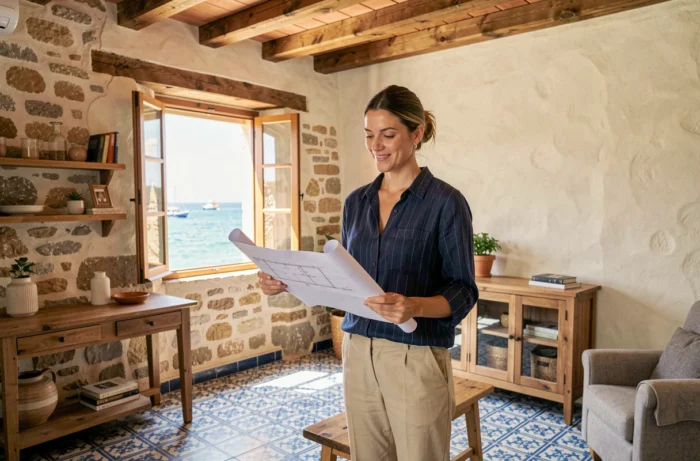
The appeal of a fisherman’s house lies in its proximity to the ocean. This proximity also constitutes its main heritage risk. According to Jornal Económico, a significant portion of the Portuguese coast is retreating, with over 100,000 people living in exposed areas.
For a buyer, the direct consequence affects renovation permits. Municipalities located in hazard zones (erosion, submersion) may restrict extension works or even deny certain building permits. Obtaining home insurance also becomes more complicated in these areas.
Checks to conduct before any purchase in coastal areas
- Consult the municipal land use plan (PDM) to identify if the property is located in a classified coastal risk zone
- Check with the town hall if renovation restrictions apply to the concerned village, particularly for extensions or elevations
- Request a home insurance quote before signing the agreement, as some insurers refuse properties located less than 50 meters from the retreating coastline
This filter eliminates certain picturesque villages but protects against future depreciation of the property. A non-insurable property loses all rental and heritage value, regardless of its architectural charm.
Rental restrictions and investment strategy in Portugal
The Portuguese tourist rental market has seen regulatory tightening in recent years. Restrictions on short-term rentals (such as Alojamento Local) are now very localized, with urban and historic areas where new licenses are frozen or heavily limited.
For a fisherman’s house, this regulation plays out in contrasting ways. Coastal villages located outside major urban areas generally maintain more flexible access to tourist licenses. Investing in a property in Ericeira, Nazaré, or on the Silver Coast does not face the same hurdles as in Lisbon or Porto.
Thus, the investment strategy depends on the project:
- As a second home with occasional seasonal rental, fishing villages outside tense zones offer a favorable regulatory framework
- For pure rental investment, profitability depends on the ability to obtain the Alojamento Local license, which requires checking on a municipality-by-municipality basis
- As a primary residence for expatriates, the cost of living is lower than in France and the possibility of tax adjustment on the IMT makes the operation financially clearer
Renovating a fisherman’s house: technical and urban planning constraints
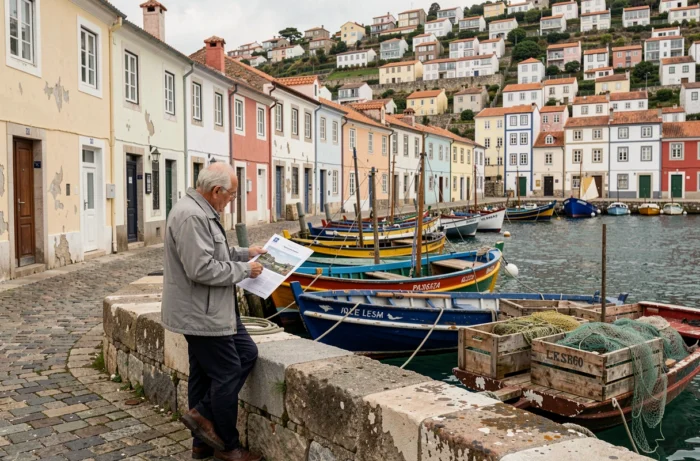
Renovating a traditional Portuguese property is not just an aesthetic choice. Fisherman’s houses are often classified or located within heritage perimeters that impose the respect of original materials and volumes.
Stone or lime masonry walls, canal tile roofs, whitewashed facades: these elements must be preserved or restored identically in many villages. The addition of a pool or a modern extension requires a specific permit, often taking longer to obtain than for a standard property.
Budget and renovation timelines
The cost of works varies greatly depending on the region and the condition of the property. Craftsmen specialized in traditional restoration are fewer on the Silver Coast than in the Algarve, where the renovation market is more structured.
Administrative timelines often constitute the main surprise. Between submitting the project to the town hall and obtaining the permit, several months can pass, especially if the property is located in a protected perimeter. Anticipating this phase before signing avoids months of capital immobilization without the possibility of works.
Portugal remains a real estate market where fisherman’s houses represent a distinct segment. Their value lies in a balance between architectural authenticity, coastal location, and local regulatory framework. The 2026 tax reform on IMT, rental restrictions by area, and coastal vulnerability form three technical parameters that every buyer must consider before signing, well before choosing the color of the shutters.