
Online tutoring is no longer just a video conference with a private teacher. The EdTech sector has evolved into an ecosystem that integrates educational management tools, adaptive software, and personalized pathways through artificial intelligence. The Ministry of National Education supports this transformation, particularly through the Édu-Up program, which funds digital solutions designed for educational continuity and inclusive schooling.
In this context, families have a range of options that far exceed the traditional private tutoring.
Territorial accessibility of online tutoring: an underestimated argument
Most comparisons highlight scheduling flexibility. While scheduling flexibility is important, it masks a more structural issue: equality of access between rural areas and urban centers. A student enrolled in a municipality with fewer than 2,000 inhabitants often has no private tutor available within a reasonable distance, let alone for specific subjects like physics-chemistry in high school or rare languages.
With an online course, this student accesses the same content and level of support as a Parisian middle school student. This geographical rebalancing changes the game for families far from major urban areas, where home tutoring remained a service effectively reserved for dense areas.
Families wishing to understand the various available options can consult digital tutoring on Soutien Adom, which details the modalities of remote support.

Personalization through AI: what adaptive pathways change
Artificial intelligence has become the dominant trend in the EdTech market. Its contribution to online tutoring occurs at three distinct levels.
- Diagnostic assessment: the tool identifies a student’s gaps even before the course begins by analyzing their responses to level-calibrated exercises
- Real-time adaptation: if the child masters a concept, the pathway moves to the next one without unnecessary repetition. If they struggle, additional exercises specifically target the identified difficulty
- Longitudinal tracking: data accumulated over several weeks allows for measuring progress and adjusting the frequency or content of sessions
This operation differs from a traditional private lesson, where the teacher often relies on their pedagogical intuition. AI does not replace the teacher; it provides a more precise diagnosis. Field feedback varies on this point: some parents observe rapid progress in mathematics, while others report that human support remains crucial for motivation, especially among primary school students.
Known limitations of online courses for young students
A 7-year-old does not use a screen like a 16-year-old high school student. The attention span in front of a digital interface varies greatly by age, and the available data does not allow for concluding that the online format is suitable for all profiles starting from first grade.
Several factors should be weighed by parents before committing:
- The duration of sessions: beyond 30 continuous minutes, a primary school student’s concentration drops. Platforms offering sessions of 45 to 60 minutes without breaks are not suitable for younger children
- Autonomy with the tool: a middle school student can navigate an interface independently. A child in second grade will need an adult nearby, which reduces the practical advantage of the remote format
- Social interaction: home tutoring creates a direct link between the child and their teacher. Online, this link exists but passes through a digital filter that can hinder trust among the more timid
However, for high school students preparing for an exam, the online format offers a clear advantage: the ability to multiply short, targeted sessions on a specific subject without the constraint of travel.
The role of the parent in the system
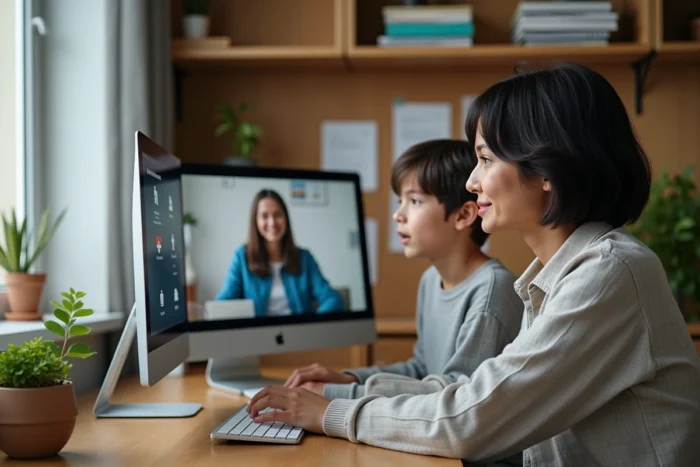
Online tutoring does not operate on autopilot. The most structured platforms offer a parental dashboard that displays progress, completed exercises, and points of blockage. This tracking requires that the parent regularly consults this data and adjusts the pace of the sessions.
Without this involvement, there is a risk that the child accumulates sessions without real engagement. The effectiveness of online support depends as much on the family environment as on the quality of the platform.
Choosing an online tutoring option: the criteria that matter
The market offers very different options, from private lessons via video conference to 100% automated pathways. Before subscribing, three criteria can effectively sort the options.
The first concerns the presence of a live teacher. A platform that limits itself to pre-recorded videos and quizzes does not offer the same level of support as a course where the student can ask questions in real time. For a struggling child, direct interaction with a teacher remains the most documented factor for progress.
The second concerns alignment with the national education curriculum. Some platforms cover all subjects from first grade to high school with content that complies with official programs. Others offer complementary approaches, useful for deepening knowledge but less suitable for immediate academic catch-up.
The third criterion is pricing transparency. Monthly subscription plans without commitment allow testing the service for a few weeks before committing long-term. Annual packages, often cheaper per month, assume certainty about the suitability of the tool for the student’s profile.
Online tutoring is becoming a permanent fixture in the French educational landscape, supported by increasingly sophisticated tools and growing institutional recognition. The decision to use it should be based on an honest assessment of the child’s profile, age, and ability to work in front of a screen, rather than solely on the promise of flexibility.