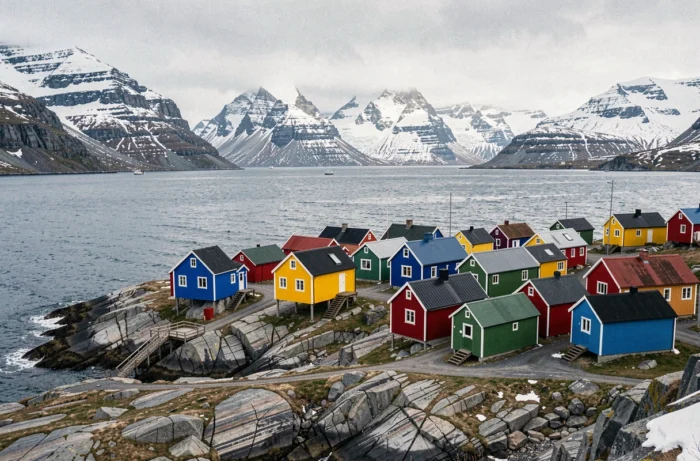
In Greenland and the Arctic regions, the facades of houses stand out against the white of the snow and the gray of the sky. Bright red, lemon yellow, deep blue: these colors are not a decorative whim. They respond to very concrete constraints related to the polar climate, Danish colonial history, and the social organization of the villages.
A color code linked to professions: identifying a building in a blizzard
Before the advent of road signs and GPS, how could one distinguish the hospital from the school when a snowstorm reduced visibility to just a few meters? The answer lay in the paint on the walls.
Each color corresponded to a specific function of the building. This system was established by Danish colonists, who imported a tradition already present in Scandinavia to Greenland. The principle was simple: a resident lost in the polar night or blizzard could identify a place just by the shade of its facade.
- Red houses indicated shops, schools, or administrative buildings.
- Yellow houses were reserved for medical staff, allowing for quick location of a care center in case of emergency.
- Blue houses designated fishermen’s workshops or activities related to the sea.
- Green houses indicated the residences of technicians or telecommunications personnel.
This code has lost its regulatory value over time. Residents now choose their colors freely. The palette remains bright, both out of cultural habit and personal preference.
The topic of Inuit and Greenlandic dwellings is also related to that of the colorful houses in Iceland, where similar logics of identification and tradition can be found.
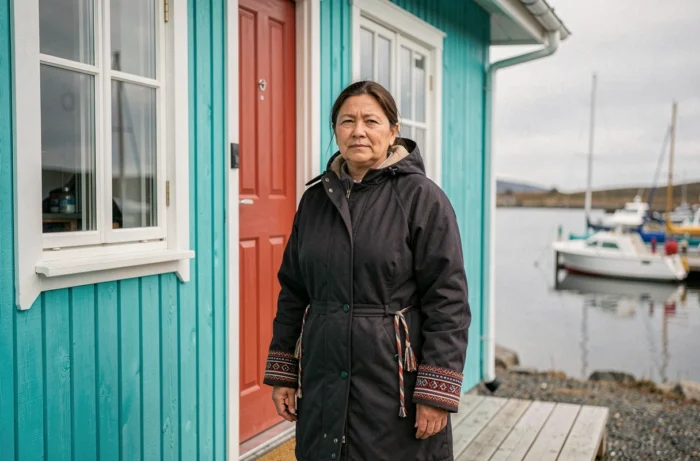
Wooden construction and Arctic climate: why paint protects houses
Greenlandic houses are built of wood, a material imported from Scandinavia in the form of prefabricated kits. Greenland has no exploitable forests. All construction wood arrives by boat, which explains the standardization of structures.
This wood, exposed to extreme cold, wind, and saline humidity, deteriorates quickly without protection. Thus, paint serves not just to decorate. It acts as a protective layer against the elements, freeze-thaw cycles, and salt carried by coastal winds.
The bright hues have an additional advantage. Saturated pigments absorb more sunlight, which contributes, even modestly, to warming the outer walls during the short summer days. In an environment where every degree counts, this detail is significant.
Before Danish colonization: colorless dwellings
Before the arrival of the Danes, the Inuit of Greenland did not live in painted wooden houses. Their dwellings were made of earth, peat, seal skins, and snow. The igloo, a temporary structure made of compacted snow blocks, served as a refuge during hunting trips.
Colorful houses are therefore a colonial legacy, not an ancient Inuit tradition. This distinction matters because it helps to understand that the current urban landscape of Greenland results from a cultural overlay, not a direct continuity with traditional ways of life.
Architectural autonomy in Greenland and Nunavut: an ongoing debate
Have you ever noticed that articles about the colorful houses of Greenland often stop at the historical anecdote? The current reality is more complex.
In Nunavut, an Inuit territory in northern Canada, architects and economists advocate for the Inuit to lead the design and construction of their housing themselves. According to Nunatsiaq News, this demand focuses on energy efficiency, simplified maintenance, and adaptation to local lifestyles. The issue is no longer just about color, but about design sovereignty.
In Greenland, the ILLU | INUA project, led by the Royal Danish Academy, illustrates this evolution. It aims to transform the first apartment blocks built during the colonial era in Sisimiut. The project involves both former and current residents in the renovation, using local materials and reuse.
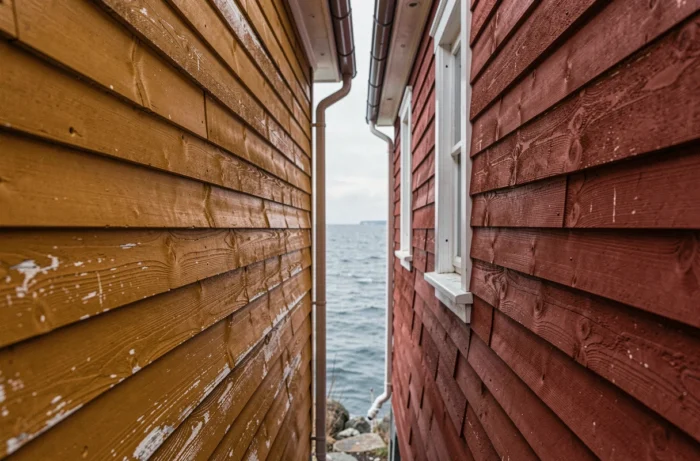
From material reuse to circular architecture in the polar environment
The ILLU | INUA project explicitly mentions the use of reused materials. In a context where everything arrives by boat and transportation costs are very high, reusing existing materials reduces both expenses and ecological footprint.
This approach marks a turning point. The colorful houses of Greenland are no longer just a postcard subject. They become the ground for a debate on climate adaptation, cultural identity, and resource management in the Arctic.
Colors of Greenlandic houses: frozen tradition or living identity
The original color code has disappeared as a rule. Residents now paint their houses according to their preferences. Some municipalities encourage the maintenance of bright palettes, aware of the tourist appeal these facades have worldwide.
This freedom of choice coexists with cultural pride. Color has become a Greenlandic identity marker, even if its origin is Danish. New constructions often adopt saturated hues, not out of obligation, but out of attachment to a recognizable urban landscape.
The next time you see a photo of colorful houses against a backdrop of ice, you will know that behind the image lie climatic constraints, a colonial legacy, and today, a movement towards architecture conceived by and for the inhabitants of the Arctic.