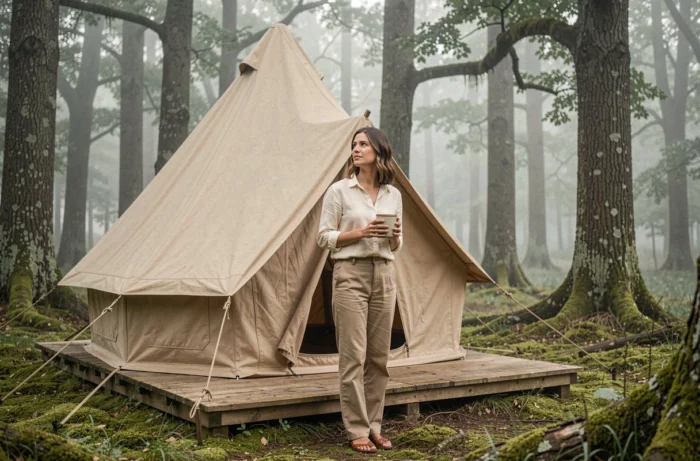
The segment of unusual accommodations in France has reached a new level of structuring in recent years. The distinction between a declared professional offer and an informal tourist rental is no longer just an administrative detail: it conditions the sustainability of the site, its insurance coverage, and the quality of the experience offered. Tombivouac, located in the Compiègne forest in Pierrefonds, illustrates this upgrade in regulated bivouacs.
Regulatory Status of Unusual Accommodations Near Paris
The law governing tourist rentals has tightened the operating conditions around the capital. Fines for rentals operated without declaration or without a change of use now exceed previous ceilings. A town hall can refuse a change of use to tourist rental if the property has served as housing in the last thirty years, unless compensated by the creation of an equivalent area of traditional housing.
This tightening has led to a documented decrease in the supply of unusual accommodations managed by individuals in the Paris suburbs. Professional structures (cabins, floating hotels, declared eco-responsible accommodations) capture the demand that informal platforms can no longer legally absorb.
For a traveler, the consequence is direct: booking with a declared structure like Tombivouac guarantees a clear legal framework, compliant civil liability insurance, and adherence to fire safety standards specific to outdoor ERP. We recommend systematically checking the declaration number at the town hall before any booking of atypical accommodation.
Among the accommodations at Tombivouac and other authentic addresses, this regulatory criterion separates viable offers from fragile proposals destined to disappear at the next inspection.
Lodges and Tipis in Pierrefonds: What the Choice of Support Hides
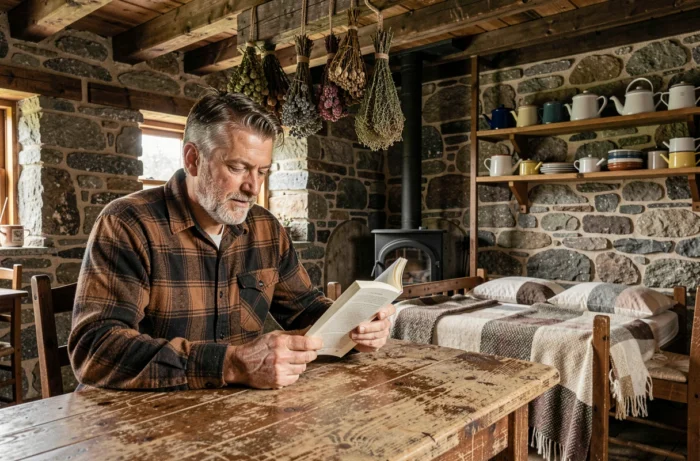
Tombivouac offers three distinct types: wooden lodge, canvas lodge, and canvas tipi. These are not cosmetic variations. The wooden lodge provides superior thermal insulation and a much longer structural lifespan. The canvas lodge, lighter, is suitable for spring and summer nights, but its technical canvas requires rigorous seasonal maintenance to avoid internal condensation.
The canvas tipi remains the most rustic format, with a conical living volume that limits furniture arrangement. It caters to an audience seeking the sensory experience of bivouacking rather than hotel comfort.
The site operates from April to October. This seasonality is not a marketing choice but a technical constraint: canvas structures cannot withstand the prolonged freeze-thaw cycles of the Compiègne forest. Wooden lodges could theoretically operate in winter, but the lack of connection to a centralized heating network makes winter operation unviable without heavy investment.
Equipment to Check Before Booking
- Bedding provided or to bring: wooden lodges generally include mattresses and duvets, while tipis may require a sleeping bag depending on the chosen option
- Sanitary access: shared or private sanitary blocks depending on the category, a point to clarify as the comfort gap is significant
- Pet policy: Tombivouac accepts pets, but with size restrictions and an additional fee to confirm during booking
- Parking: parking is available on-site, which is not always the case in forest accommodations where vehicle access may be limited to drop-off only
Compiègne Forest: An Environment That Structures the Offer
Located in the Compiègne forest, near the Château de Pierrefonds, Tombivouac is positioned in a specific niche: nature disconnection less than an hour from Paris. This geographical positioning explains a clientele primarily from the Île-de-France region on short stays.
The forest itself imposes operational constraints. Parcels in forest zones are subject to strict land use rules. The installation of permanent structures is regulated by the forestry code, which limits the expansion of accommodation capacities.
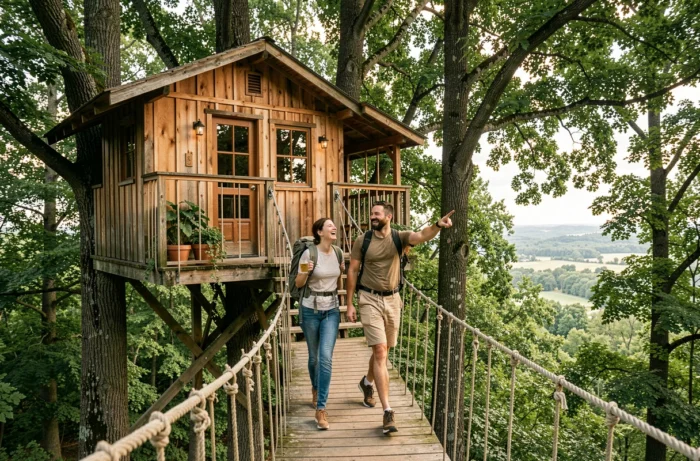
For travelers seeking a stay centered around outdoor activities, the proximity to the Château de Pierrefonds and the marked trails of the Compiègne forest is a tangible asset. Cyclists benefit from dedicated facilities on-site, a detail that reflects a thoughtful segmentation of the clientele.
Comparing Tombivouac to Other Unusual Tourism Addresses in the Forest
The market for unusual accommodations in France has generated, according to the Observatory of the Unusual (Unic Stay / AbracadaRoom and the Alliances firm, cited by Paris Match in July 2026), 430 million euros in revenue. This figure confirms that the segment has surpassed the niche stage.
We observe three differentiation criteria among professional players:
- The level of energy autonomy: some sites operate on solar power with battery storage, while others remain connected to the grid, which alters the actual ecological footprint of the stay
- Price transparency: a price per night displayed without hidden fees (cleaning, linen, tourist tax) remains the exception rather than the norm in this segment
- Territorial anchoring: a site that works with local producers for catering or activities creates added value that mere accommodation provision does not provide
Tombivouac positions itself in the comfort bivouac niche with integrated services (cyclist welcome, pets accepted, proximity to a classified heritage site). Other addresses, particularly in Oise or northern France, focus on different formats (treehouses, transparent bubbles, tiny houses) with varying levels of service.
The choice between these options depends less on budget than on the accepted balance between rusticity and comfort. A heated wooden lodge in Pierrefonds and a transparent bubble without private sanitation do not cater to the same traveler profile, even if both carry the label “unusual accommodation.”