
Organizing a children’s party is not just about stacking activities. The real lever, the one that transforms a noisy afternoon into a lasting memory, is the coherence between the venue, the number of guests, and the rhythm of the activities. Before choosing a theme or ordering a cake, this initial framing avoids most hiccups.
Children’s party outside the home: rules to know before booking
Competitors rarely talk about this point, but it changes the entire organization. As soon as the party moves out of the private home, legal obligations apply. A community hall, a public park, or a temporary inflatable structure may be subject to rules related to establishments open to the public (ERP), prior declarations to the town hall, or even specific authorizations.
Renting a community hall for a dozen children seems simple. In practice, check the authorized capacity, the presence of fire extinguishers, and the evacuation conditions. Some municipalities require a reservation form accompanied by a civil liability insurance certificate.
For activities with temporary structures (bouncy castle, obstacle course), the provider must provide their own compliance certificates. Request them in writing before signing. This reflex avoids unpleasant surprises on the big day, especially if a child gets injured and the question of liability arises.
Several specialized providers offer turnkey packages that incorporate these logistical constraints. This is the case on joker-amusement.com, where the activities are designed to adapt to different venues and configurations.
Age-appropriate activities for children: three age groups, three approaches
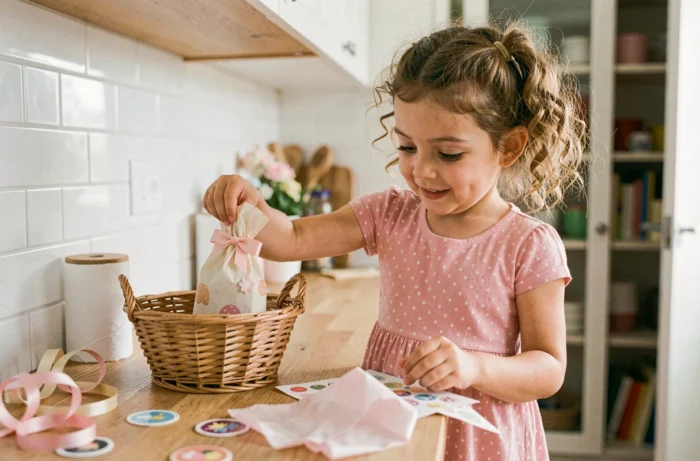
Have you ever noticed that a game that excites four-year-olds deeply bores nine-year-olds? The age of the guests determines the format, duration, and complexity of the activities. It’s better to have three well-calibrated activities than a dozen that fall flat.
Children aged 3 to 5: sensory and short
At this age, attention spans rarely exceed fifteen minutes per activity. Focus on sensory workshops: colorful playdough, finger painting, indoor sandboxes. The common thread can be a simple character (an animal, a cartoon hero) that connects each workshop to the next.
Plan for smooth transitions. A four-year-old does not switch from a noisy activity to a calm one without a clear signal. A nursery rhyme, a collective countdown, or a change of room is sufficient.
Children aged 6 to 8: cooperation and small challenges
This is the age group where group games work best. A themed treasure hunt remains a safe bet, provided you create real teams with roles (the decoder, the seeker, the reporter). A scenario with twists keeps attention much better than a simple sequence of clues.
The cooking workshop is also perfect. Decorating cookies or assembling mini-pizzas gives each child a tangible result to take home. Plan for a protected table, aprons, and recipes that require no cooking on-site.
Children aged 9 to 12: autonomy and friendly competition
Older kids want to feel like active participants. A home escape game (code locks, sealed envelopes, logical puzzles) gives them that sense of autonomy. Prepare clues of increasing difficulty so that the group does not get stuck for too long.
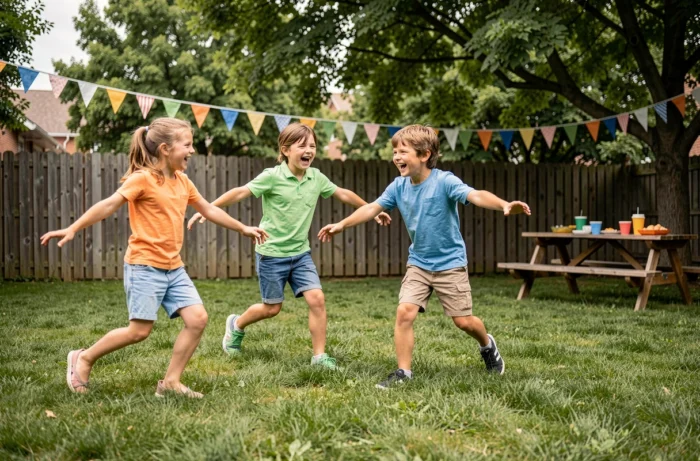
The sports tournament (relay races, obstacle courses, tug-of-war) also works, provided you balance the teams and plan a cumulative points system rather than direct elimination. The goal: to ensure that no one is sitting idly by.
Toy safety and snack time: two often overlooked angles
The visible part of a party is the decoration and games. The part that can pose a problem is what the children handle and eat.
Toys given as party favors: caution with squishies
Stress-relief toys like squishies are very popular as small party favors. The DGCCRF recently issued a warning about these products. Several accidents have been reported, including second-degree burns after a defective squishy burst.
Check for CE marking, the minimum age indicated, and the absence of abnormal odors. If the product shows any deterioration (cracks, sticky texture), do not distribute it. Opt for safer alternatives: personalized notebooks, small coloring kits, bags of marbles.
Homemade cake and buffet: what the regulations say
In a private and small-scale setting, a homemade cake does not fall under the formal food obligations imposed on professionals. This distinction allows for a “homemade” buffet to be prepared without a health certificate.
However, if the party takes place in a collective structure (daycare center, hall with a caterer), the rules change. The cake brought by the family may be refused for hygiene reasons. Check with the venue before spending two hours in the kitchen.
Rhythm and duration of a children’s party: the rule of relaxation
Why do some parties derail after an hour while others flow smoothly for three hours? The secret lies in the rhythm, not the number of activities.
Systematically alternate:
- A physical activity (running, dancing, obstacle course) followed by a calm activity (coloring, listening to a story, craft workshop)
- A collective time (team game) followed by an individual time (each child creates their own)
- A structured moment (specific rules, an adult guiding) followed by free time (children play among themselves without instructions)
This pattern works regardless of age. It prevents the cumulative excitement phenomenon that makes the last minutes unmanageable.
Plan for a buffer of about twenty minutes in your schedule. A game that is popular may last longer than expected. Forcing the transition to the next activity frustrates children and creates unnecessary tension.
The snack should ideally be placed two-thirds of the way through the party, not at the end. A child who has eaten cake and candy ten minutes before leaving will leave overly excited. Placed earlier, the snack becomes a natural break that recharges energy for the final activity.
The total duration depends on age. For three to five-year-olds, an hour and a half to two hours is more than sufficient. For six to eight-year-olds, plan for two to three hours. Beyond that, even the oldest get tired, and parents picking up exhausted children do not have fond memories of the afternoon.