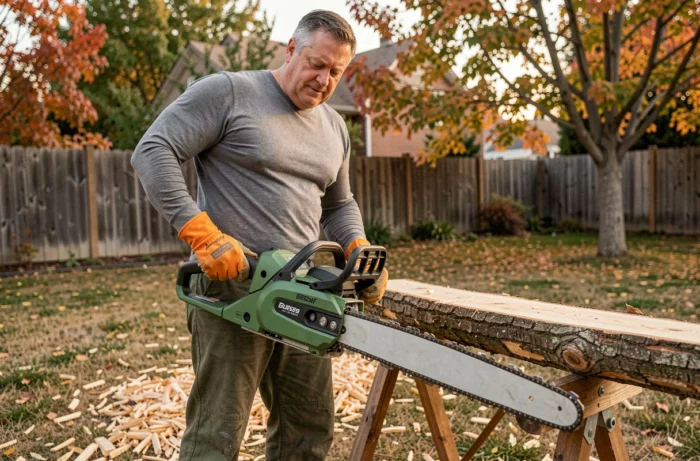
The Ryobi OCS1830 chainsaw operates on the 18V ONE+ platform, placing it within an ecosystem of shared batteries with dozens of tools. This compatibility is a game changer for those who already own Ryobi equipment, but it also raises a central question: what level of performance can one expect from a chainsaw powered by a single 18V battery, compared to 36V or gas models?
Technical specifications of the Ryobi OCS1830 compared to common alternatives
| Feature | Ryobi OCS1830 (18V) | 36V chainsaw type |
|---|---|---|
| Voltage | 18V | 36V (2x18V) |
| Bar length | 30 cm | 30 to 35 cm |
| Chain pitch | 3/8″ low profile | 3/8″ low profile |
| Motor | Brushless | Brushless (depending on model) |
| Lubrication | Automatic | Automatic |
| Battery included | No | Variable |
| Battery compatibility | Any ONE+ 18V battery | Specific or dual slot |
The 30 cm bar limits cuts to modest sections, typically branches and small firewood. 36V models, which double the voltage, offer superior torque on hardwoods or larger diameters.
For those who want to delve deeper into the specifications and field feedback, you can discover the Ryobi OCS1830 on tronconneuse.xyz with a dedicated file for this model.
18V ONE+ battery and 2026 rebranding: what changes for the OCS1830
Most tests published on this chainsaw were conducted with 2 Ah or 4 Ah packs from the previous generation. Since 2026, Ryobi has restructured its battery range. The old High Performance batteries are now called 18V ONE+ Lithium, while the High Performance EDGE become 18V ONE+ Lithium EDGE.
This change is not cosmetic. The new packs incorporate Intellicell electronics and Cool-Core thermal management, designed to limit downgrading under heavy load. On a chainsaw, heavy load is almost constant: every cut pushes the motor to its maximum.
Concrete impact on runtime and cutting consistency
With a 2 Ah Lithium pack, the runtime remains short, suitable for a few occasional cuts. In contrast, a high-capacity Lithium EDGE pack (8 Ah or 12 Ah) significantly alters the experience: the chainsaw maintains a more stable speed for longer, and thermal downgrading occurs much later in the session.
Tests prior to this rebranding do not document this gap. Testing the OCS1830 in 2026 without specifying the generation of battery used amounts to comparing incomparable results.
Real cutting capacity on softwood and hardwood
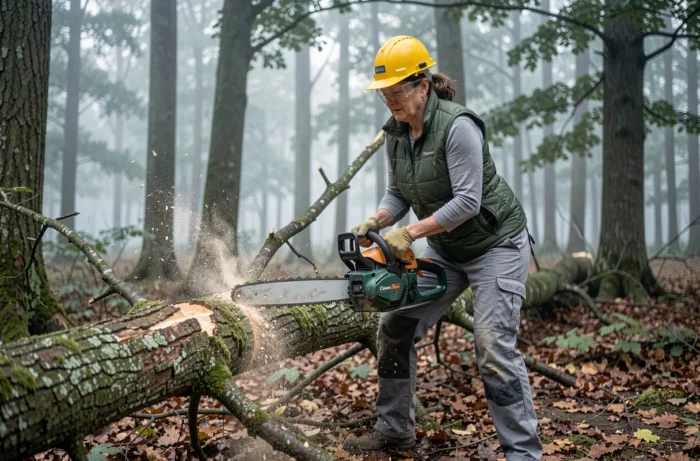
The 30 cm bar and the 3/8″ low profile chain clearly direct this chainsaw towards pruning and cutting softwood (softwood, poplar, birch). On these species, the chain progresses without notable effort and the cutting speed remains satisfactory.
On hardwood (oak, beech, ash), the situation changes. The 18V motor reaches its torque limits, the chain visibly slows down, and the battery discharges more quickly. This is not a design flaw; it is the physical consequence of an 18V voltage against dense fibers.
- Pruning branches up to 20-25 cm in diameter in softwood: main and comfortable use for the OCS1830
- Cutting logs of hardwood in modest diameter: feasible but slow, with reduced runtime of about half
- Felling or forestry work: out of scope, the power and bar length are insufficient
This chainsaw is a tool for regular maintenance, not a production tool. The distinction is rarely stated as clearly in competing specifications, which often remain vague about limits in hardwood.
Automatic lubrication and chain maintenance
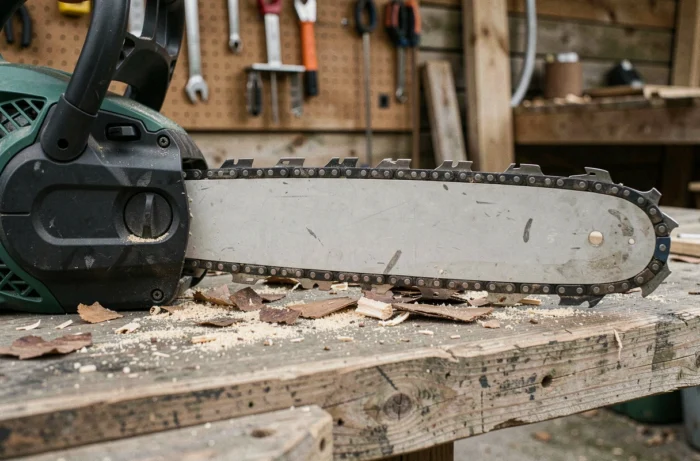
The Ryobi OCS1830 features a automatic chain lubrication system, powered by an integrated oil reservoir. This system reduces wear on the chain and guide, provided the oil level is checked before each session. A dry guide causes rapid overheating and premature wear of the links.
Tool-free chain tensioning
The tension adjustment is done without tools, via a side knob. In practice, the chain loosens after a few cuts, especially when cold. Therefore, it needs to be retightened regularly during the first few minutes of use.
The original chain is adequate for light use. For regular use, replacing it with a specialized brand chain (Oregon, for example) improves the quality and speed of cutting, without excessive additional cost.
Safety and ergonomics of the Ryobi OCS1830
The rubber-wrapped front handle limits vibrations transmitted to the hands. The chain brake, manually activated by the front hand guard, stops the chain in case of kickback. These two elements are standard on modern chainsaws, but their presence on an entry-level 18V model is worth noting.
- Lightweight (without battery), which reduces fatigue during high or prolonged cuts
- Operational and responsive manual chain brake
- Compact dimensions (approximately 45 x 23 x 18 cm) facilitating storage and transport
- Battery sold separately, a point to anticipate in the total budget if one does not already own the ONE+ ecosystem
The absence of a battery in the box is a common commercial choice by Ryobi. For a user already equipped with ONE+, it is an advantage: the purchase price decreases and existing batteries are reused. For a first-time buyer, the actual cost necessarily includes a battery pack and a charger.
The data that best summarizes the Ryobi OCS1830 is its voltage: 18V. It sets both the power ceiling and the usage perimeter. On softwood and regular maintenance, this chainsaw reliably fulfills its role. The choice of battery, especially since the Lithium EDGE rebranding in 2026, becomes the real lever to get the best out of it.