
Pruning some dead branches on an apple tree, clearing the dry wood that accumulates near a fence, shortening an overgrown hedge: these tasks come back every year in most gardens. The choice of pruner determines both the time spent and the level of risk.
Between the increasingly available battery-powered mini-chainsaws online and the telescopic poles intended for professionals, the range has significantly expanded in recent years. The decision becomes more complicated for an individual simply looking for a tool suitable for their land.
Oversized pruner: the most common trap in small gardens
The classic temptation is to buy a powerful machine “just in case.” On a plot of a few hundred square meters, a high-displacement gas-powered pruner becomes a hindrance: heavy weight, noise, maintenance of the two-stroke engine, and especially a guide bar that is too long for small diameter branches.
Recent guides and product tests increasingly highlight compact battery-powered pruners as a credible alternative for this type of use. Their main advantage is maneuverability: some can be operated with one hand, allowing for quick interventions without setting up a ladder or putting on a harness. The time saved on routine pruning (dead wood, low branches, regrowth) is real.
The catalogs available on elagueuse-warrior.com allow for comparisons between compact formats and more robust models, helping to calibrate the purchase according to the actual size of the garden rather than a hypothetical scenario.
However, a mini-pruner quickly reaches its limits on hard wood or diameters greater than about ten centimeters. Adapting the tool to the diameter of the branches, not to the surface area of the land, remains the most reliable rule to avoid an unnecessary purchase.

Battery, gas, or corded: what motorization really changes in daily use
The debate on motorization occupies the majority of buying guides, but it often boils down to a comparative table without clear hierarchy. Three elements deserve to be isolated for regular domestic use.
Actual autonomy of a battery-powered pruner
The autonomy advertised by manufacturers rarely corresponds to usage under load, meaning effective cutting in green wood. Field feedback varies on this point: depending on the type of wood and the condition of the chain, the actual cutting duration can vary from one to two times compared to the technical specifications. Having a second battery then becomes less of a luxury and more of a necessity to finish a session without interruption.
Maintenance of gas engines: a hidden cost
A gas-powered pruner requires regular maintenance of the air filter, spark plug, and carburetor. For an individual who uses it for a few hours a year, the time spent maintaining the engine can exceed the cutting time. This imbalance is pushing more and more occasional gardeners towards battery-powered options, despite lower cutting power on larger diameters.
Corded pruner: a very limited use case
The corded model remains confined to hedges near an outdoor outlet. Its average power and the constraint of the cable make it a relevant choice only for light cuts in a fixed position. For pruning at height or while moving around the garden, the extension cord becomes a risk factor.
Safety and prevention: what pruning changes beyond aesthetics
Pruning is increasingly presented as a fire prevention measure, not just as aesthetic maintenance. Removing dead wood, clearing low branches near buildings, and reducing the vegetation mass in contact with walls or roofs limits the spread of a fire. This preventive dimension concerns all gardens, including in dense urban areas.
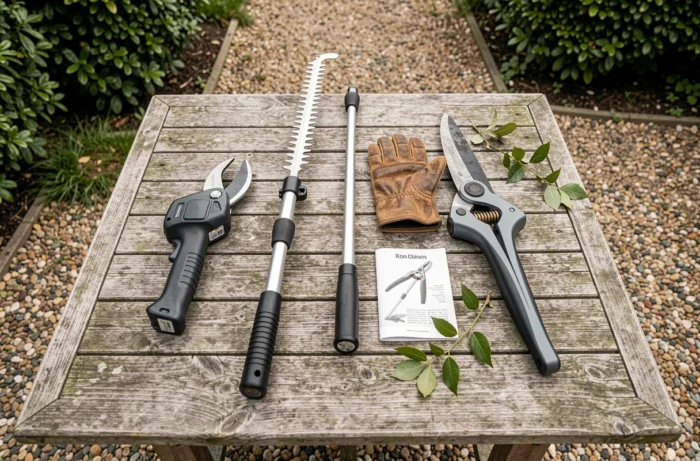
- Pruning poles, fixed or telescopic, allow for high interventions from the ground, without a ladder or harness, reducing the risk of falls for individuals.
- Pruners with adjustable heads offer an adjustable cutting angle, which avoids dangerous postures to reach off-center branches.
- Wearing cut-resistant gloves, protective eyewear, and ear protection is recommended regardless of the type of machine, including battery-powered ones.
Concrete selection criteria for a pruner suitable for domestic use
Rather than an exhaustive grid, four parameters are sufficient to eliminate the majority of unsuitable models.
- The maximum diameter of branches to be cut determines the length of the necessary guide bar. For routine maintenance (branches up to eight or ten centimeters), a short guide is sufficient and makes the machine lighter.
- The total weight in working order (including battery) conditions the duration of use without fatigue. Beyond four to five kilograms held at arm’s length, cutting precision decreases rapidly.
- The compatibility of the battery with other tools from the same brand can reduce the overall cost of garden equipment.
- The tool-free chain tensioning system speeds up startup and limits adjustment errors for non-professional users.
The choice between a pruning pole and a pruning chainsaw mainly depends on the height of intervention. If most cuts are made above two meters, the telescopic pole avoids the need to buy a ladder and the associated risks. For mixed work (ground and moderate height), a compact battery-powered pruning chainsaw covers most needs.
Regular maintenance of the chain (sharpening, tensioning, lubrication) has more impact on cutting efficiency than the nominal power of the motor. A well-sharpened chain on a small machine cuts faster than a worn chain on a powerful model. This is probably the most underestimated parameter by buyers who only compare watts or cubic centimeters.