
A laurel that turns brown in the center after a too-severe pruning, thujas with holes in the middle because old wood was cut: these mistakes can be seen in most gardens, and they are often irreversible. Trimming a hedge is not just about using the hedge trimmer twice a year. The shape of the cut, the regulatory calendar, and the choice of species condition both the aesthetics and the durability of the hedge.
Trapezoidal cut profile: the technical basis of a hedge that does not become bare
Most residential hedges are trimmed vertically, with perfectly straight sides. The result looks neat in the first few years, then the bottom gradually becomes bare. The reason is simple: the upper branches, more exposed to sunlight, capture most of the light and eventually smother the lower vegetation.
Trimming in a trapezoid, wider at the base than at the top, corrects this imbalance. Light reaches the lower branches, which remain active and produce dense foliage down to the ground. We talk about a slope angle of just a few degrees, enough to radically change the light distribution without altering the overall appearance of the hedge.
For evergreen species like privet or photinia, this profile makes the difference between an opaque hedge at its full height and a screen riddled with brown holes at mid-height. Specialized resources like sculpte-haie.com detail these cutting principles adapted to each type of shrub.
Summer pruning ban: what the regulations impose since 2024
Pruning your hedge in the middle of summer, between June and August, seemed harmless a few years ago. This is no longer the case. The tightening of the BCAE 8 framework (CAP conditionality) has extended the pruning ban period from March 16 to August 15, compared to a shorter schedule before. This rule targets farmers receiving aid, but it reflects a trend that is gradually affecting individuals.
Some municipalities are issuing local orders prohibiting pruning during the nesting period, including in private gardens. Fines can exceed several hundred euros. Beyond the penalty, the observation is concrete: by clearing branches from a hedge in June, active nests with chicks are regularly found.
Adapting your pruning schedule to the terrain
In practice, intervention occurs twice a year on a classic hedge:
- A main pruning in late winter (February-March), before bud break, when the sap is still low and the birds have not yet nested
- A finishing trim in late summer (September), after the nesting period, to reshape the summer growth
- A systematic visual check before each intervention: clear the branches, check for the absence of nests, identify already bare areas that are better left untouched
Feedback varies on this point depending on regions and species, but this two-pass framework avoids most regulatory conflicts and yields better results than a single trim in June.
Unique hedge regime: replanting obligation and heritage management
A major legislative change modifies how one can intervene on their hedges. The new unique hedge regime now imposes, in case of destruction, a replanting obligation along a linear distance at least equal to that removed. This is no longer just a good neighborly advice, it’s a legal constraint.
For a garden, the direct consequence is that one can no longer uproot an aging hedge without planning for its replacement. This encourages maintenance rather than replacement, and anticipates long-term management.
Choosing species that withstand repeated pruning
Not all species react the same way to frequent cuts. The thuja, for example, does not regrow on old wood. A severe cut leaves permanent brown holes. Hornbeam, beech, or privet, on the other hand, regenerate easily from old wood.
For an elegant garden with minimal maintenance, species with moderate growth that respond well to trapezoidal pruning are favored:
- Hornbeam (Carpinus betulus): marcescent, it retains its dry leaves in winter and provides a privacy screen all year round, with excellent tolerance to cutting
- Photinia: evergreen foliage, decorative red shoots in spring, good natural density
- Privet (Ligustrum): semi-evergreen depending on the varieties, it grows quickly but is easily controlled with two annual trims
- Yew (Taxus baccata): slow growth, ideal for sculpted shapes, tolerates shade and regrows on old wood
Sculpted hedge or free hedge: two approaches for very different results
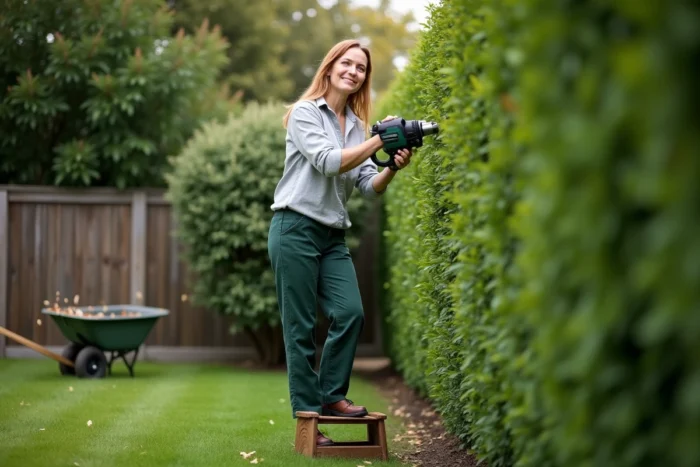
The straight, uniform hedge remains the norm in French gardens. It requires regular maintenance, suitable equipment (thermal hedge trimmer or pole trimmer for heights), and a certain rigor in the action. To perfectly align the top, the most reliable method is to stretch a string between two stakes before cutting.
The free hedge, on the other hand, allows the shrubs to express their natural form. Intervention is only made to remove dead wood or limit overcrowding. Less work, but more space required: a free hedge can reach two meters wide, compared to about sixty centimeters for a trimmed hedge.
The choice depends on the terrain configuration. At the property line, regulations generally impose a planting setback (variable according to local regulations and the intended height). A free hedge planted too close to the fence will eventually overflow into the neighbor’s yard, a classic source of neighborly disputes.
Combining both styles in the same garden
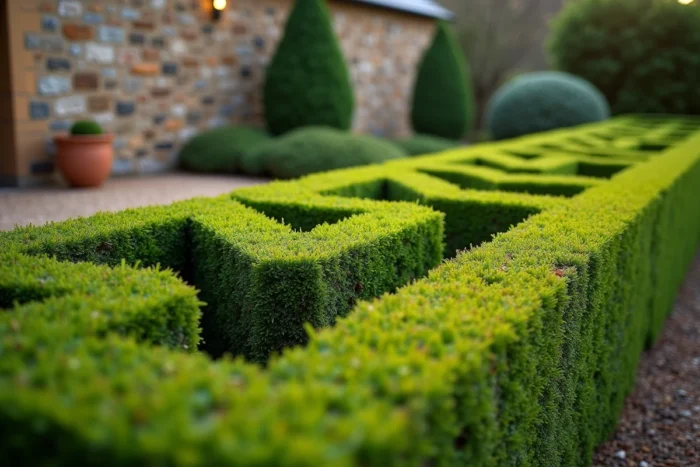
You can structure the front of the garden with a low trimmed hedge (boxwood, lonicera nitida) and leave the back as a mixed wild hedge. This contrast creates visual depth and reduces overall maintenance time, as only the part visible from the street requires careful cutting.
The most accomplished result combines a rigorous trapezoidal profile on the structural hedges and gentle trimming, with shears, on flowering or fruiting shrubs. Each pruning intervention shapes the hedge for the following seasons: it is better to have two thoughtful cuts a year than a hasty monthly pass that weakens the shrubs without densifying them.