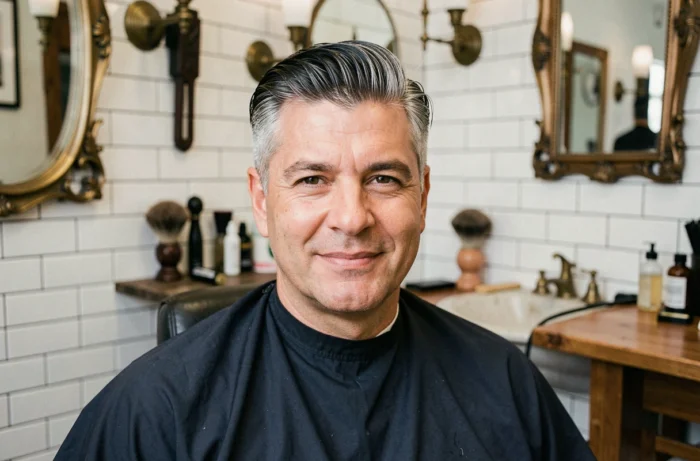
The first white hairs often appear at the temples, then spread to the top of the head within a few months. Two classic options then present themselves: cover everything with an opaque dye, or let it be. Grey blending offers a third, more calibrated path. This technique does not mask gray hair; it blends it into the mass to soften the contrast without freezing the appearance.
Tonal gap and light: what makes gray hair so visible in men
A white hair does not pose a color problem, but a light reflection issue. Its melanin-free structure reflects light in a raw manner, creating a marked contrast with the remaining pigmented hair. On a short haircut, this contrast is striking because each hair is visually isolated.
Grey blending addresses this tonal gap. The colorist applies intermediate shades, neither the original color nor pure white, to reduce the light distance between the two types of hair. The result does not resemble a dye. It looks like a more homogeneous version of what is already there.
This approach works even better when the natural base is dark: chestnut, brown, or black. The stronger the initial contrast, the more visible the tonal reduction effect. On a blonde or light chestnut base, the gap is already small, and the technique brings less noticeable change.
Understanding grey blending for men helps grasp why this technique stands out from a simple classic balayage: it does not aim to lighten or create decorative highlights, but to harmonize what time has begun to alter.
Men’s grey blending in salons or barbershops: two different approaches
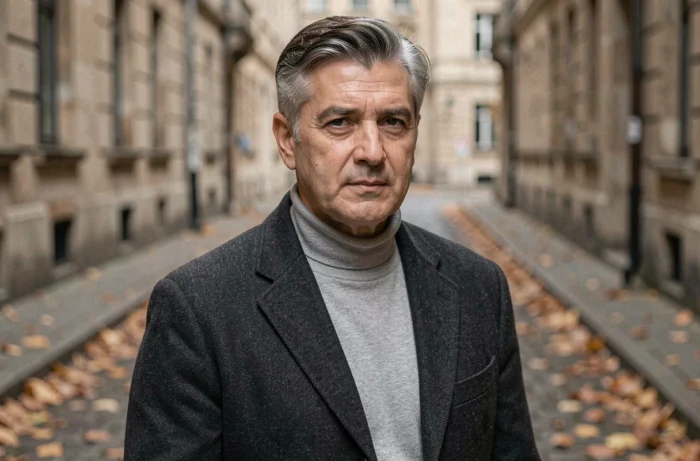
Have you noticed that some barbershops now offer gray hair camouflage services? The technique used in these establishments is not always the same as that practiced in a traditional hair salon.
In a barbershop, grey blending often takes the form of a short service integrated into the haircut, with a reduced processing time and low-hold semi-permanent products. The goal is a discreet result that fades in a few weeks, compatible with regular visits every three to four weeks.
In a salon, the colorist has more latitude. They can work strand by strand, adapt the formulation to each area of the head (temples, vertex, nape), and play with multiple levels of tones. The result lasts longer, but the session also takes more time.
Which setting to choose based on your level of gray
If your white hairs represent a moderate proportion, concentrated at the temples, a visit to a barbershop is usually sufficient. The quick treatment softens the contrast without altering the overall look.
When gray covers a larger part of the hair, salon work allows for a progressive fade zone by zone. The colorist can then create a natural gradation between the forehead, sides, and back of the head, which a uniform treatment cannot achieve.
Maintenance of men’s grey blending: frequency and suitable products
Grey blending does not create a root effect in the traditional sense. Since the technique does not fully cover white hairs, regrowth does not produce a sharp demarcation. This is one of its most significant practical advantages compared to traditional dyeing.
The touch-up frequency depends on the type of product used. A demi-permanent applied in a barbershop fades in three to five shampoos. A salon formulation with a light oxidizer can last six to eight weeks depending on the hair’s porosity.
Between sessions, a few actions can prolong the result:
- Use a sulfate-free shampoo to slow down the washing out of pigments deposited on the hair fiber.
- Space out washes when possible: each shampoo removes a fine layer of semi-permanent pigment.
- Apply a UV protective treatment in summer, as the sun accelerates the oxidation of warm shades and can shift the result towards undesirable tones.
Gray hair and short cuts: why length changes everything
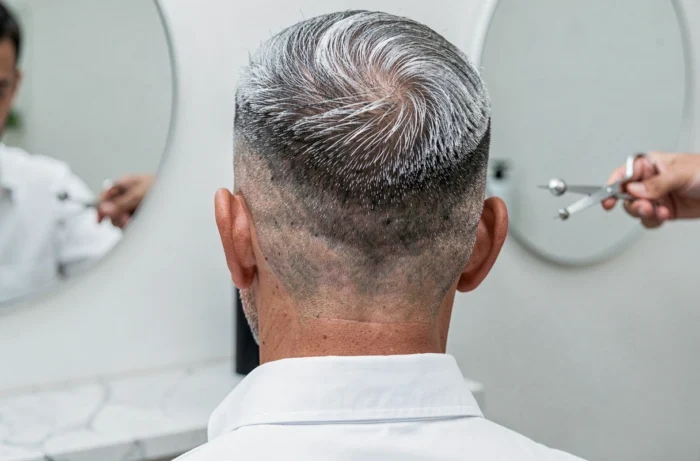
On a long cut, white hairs blend with pigmented strands through movement. The volume creates a natural optical mix. On a short cut or tight fade, each hair is individually exposed.
This is why grey blending produces its best results on cuts of three to six centimeters. At this length, the technique has enough surface to create a fade while remaining in a typically masculine format.
A well-executed fade complements the color work. By keeping the sides shorter (where gray often appears first) and maintaining length on top, the barber creates a structural contrast that diverts attention from the color gap.
The trap of being too short
Below two centimeters, grey blending loses its effectiveness. The hairs are too short for the semi-permanent pigment to cling durably. The result fades in a few days, and the cost-to-duration ratio becomes unfavorable. At this length, leaving the gray visible often remains the most coherent choice.
Classic dyeing, balayage, or grey blending: guidelines for choosing
These three techniques do not have the same objective, and confusing them leads to disappointments.
- Classic dyeing fully covers white hairs. It provides a uniform result but creates a visible root effect as early as the second week of regrowth.
- Balayage adds light highlights on a natural base. It does not specifically target gray hairs and can even make them more noticeable if the contrast is poorly calibrated.
- Grey blending reduces the gap between pigmented and white hairs without eliminating the latter. The result evolves with regrowth instead of contradicting it.
For a man who wants to maintain a natural appearance without a monthly dyeing routine, grey blending offers the best compromise between intervention and discretion. The men’s dyeing market is also experiencing steady growth, and this technique represents the fastest-growing segment.
The final choice depends on your proportion of white hairs, the length you wear, and the time you are willing to invest in maintenance. An initial appointment with a specialized colorist allows for an accurate diagnosis before any application.