
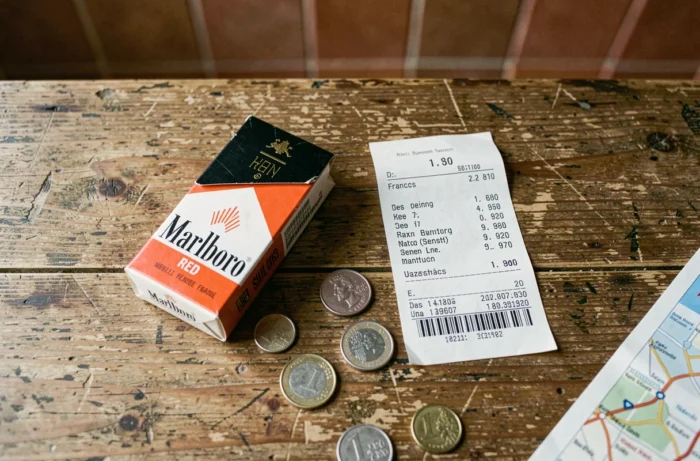
In August 2026, a pack of Marlboro costs about 13.50 euros in France compared to 8.50 to 8.70 euros in Germany. The gap exceeds four euros per pack, and it widens further when considering a carton. This difference fuels a regular cross-border flow, particularly in the Grand Est and the North. Available data shows that this gap, although still significant, is beginning to narrow due to divergent tax schedules.
Six French decrees in eight months: an unprecedented increase mechanism
France adopted an unprecedented rate of price revision in 2026. Six successive decrees between January and August 2026 modified the approved tobacco prices, compared to two or three per year in previous years. Each decree, published in the Official Journal by the General Directorate of Customs and Indirect Rights, covers all references sold on the territory.
The first decree, dated January 5, 2026, pushed several brands above the symbolic threshold of 12 euros for a pack of 20. Additional increments are scheduled for September, November 2026, and January 2027. This staggered pace aims to smooth the impact on consumption, but it also complicates the understanding of real prices for smokers.
Data published by French customs allows for a detailed comparison of Marlboro carton prices and tobacco in Germany 2026 by aligning them with updated French rates month by month. The gap on a carton of Marlboro Red (10 packs of 20) is around 50 euros in favor of Germany, a figure that justifies, for many cross-border shoppers, the trip.

German excise increase schedule until 2030
Germany has voted on a multi-year plan to raise excise taxes on tobacco, with annual increments planned until 2030. This plan, led by the Federal Ministry of Finance, anticipates a steady increase in the average price of a pack.
According to projections reported by Infoestancos (based on the German legislative project), the average price of a pack in Germany is expected to reach around 9.10 euros in 2027, then progress to 9.91 euros in 2028, 10.81 euros in 2029, and about 11.78 euros in 2030. The trajectory is clear: the France-Germany gap is narrowing year by year.
In France, the government has not yet set a price target for 2030, but recent dynamics suggest that the average pack could exceed 14 euros before the end of the decade. The gap would therefore remain positive for consumers buying in Germany, but it could decrease from more than four euros today to potentially two euros or less by 2030.
What this means for tobacco tourism
A gap of two euros per pack (or about twenty euros per carton) no longer justifies a several-hour trip for an occasional smoker. Cross-border shoppers from the Grand Est or the North will likely continue to take advantage of it during already planned trips, but the profitability calculation for a dedicated tobacco trip becomes less clear as prices converge.
European directive in preparation: a new tightening
Alongside national schedules, the European Union is preparing a revision of its tobacco directive. In August 2026, Euronews reported that the Commission was considering rewriting the rules applicable to tobacco products for future generations, which could include raising minimum excise taxes at the community level.
If such an increase were adopted, it would affect more countries where tobacco remains lightly taxed (Eastern Europe, some Southern countries) than France, which is already among the most expensive on the continent. In contrast, Germany, whose prices remain in the lower average of Western Europe, would be directly affected.
- France is among the continental European countries where the pack of Marlboro is the most expensive, according to the Tobacco Review.
- Germany applies lower excise taxes than France, but its scheduled increases are gradually reducing this advantage.
- A rise in European minimums would accelerate the convergence of prices between the two countries.
Field reports vary on the actual scale of the cross-border phenomenon. French customs report regular seizures, but volumes remain difficult to quantify accurately, especially since purchases within the legal limit (one carton per person coming from an EU country, for personal use) are not subject to any declaration.
Rolling tobacco and niche products: sometimes more pronounced gaps
Rolling tobacco often presents a proportionally larger gap than manufactured cigarettes. In France, the price of a 30g pack has followed the same upward trajectory as traditional cigarettes, with successive increases in 2026. In Germany, rolling tobacco remains significantly cheaper, making it a particularly sought-after product by cross-border buyers.
Heated tobacco products (such as HEETS or Terea, compatible with IQOS devices) also show a differential between the two countries, although the comparison base is more recent and prices are closer. These products represent an increasing share of the German market.
Counterfeiting and the parallel market
A network trafficking counterfeit cigarettes was dismantled in Lille in 2026, with estimated damages of 12 million euros. This type of case illustrates a collateral effect of the price gap: the more expensive tobacco is in France, the more the parallel market (counterfeiting, illegal sales) develops. High prices not only reduce legal consumption, but also shift some demand towards uncontrolled channels.
The French increase of 33% year-on-year in July 2026, reported by Devizu News, places the issue of tobacco pricing at the center of public health decisions. Reducing consumption remains the stated goal, but trafficking and cross-border purchases absorb some of the expected effects.
The gap between France and Germany regarding tobacco prices remains a structural fact in 2026, even if it is diminishing. European fiscal convergence and German increase plans outline a horizon where the difference will no longer be sufficient to justify a trip. For cross-border smokers, the window for significant savings is gradually closing.